
Is a $200+ Baby Mat Worth It? Foam Mats vs Cheaper Gyms in Australia
The decision usually arrives mid-scroll, with a baby on your shoulder. One tab shows a play gym with dangling toys. The next shows a giant foam baby mat with a much bigger price tag. Both are sold as “the place baby plays”, and nothing on the page tells you which one you actually need.
Here is the short version. A baby playmat is really two different products. A play gym (a soft mat with an arch of toys) does its job from birth to about six months. A thick foam floor mat comes into its own from around six months, once a baby is rolling, sitting and crawling, and that is where the $200+ price tags live. This guide compares manufacturer specifications and the relevant Australian Standards.
We have not handled these products ourselves. Everything below comes from manufacturer specifications and the relevant Australian Standards.
Is a $200+ foam baby mat actually worth it?
Spend $200+ only if your floors are hard (tile, timber, polished concrete) and your baby is rolling or crawling, which is usually from around six months. In any other situation, a cheaper foam mat does the same job, and a rug can do much of it too. Before paying premium money, compare the live price of a mainstream foam mat of similar size and thickness on the cards below. If the thickness matches, the extra spend is mostly brand, colour and print.
When a premium foam mat earns its price
- Hard floors throughout: if the living area is tile or timber, a thick, cushioned surface takes the sting out of the inevitable sideways topple.
- Rolling, sitting and crawling: from around six months through to toddling, when a baby spends hours on the floor and falls constantly.
- One big, shared play zone: a large mat can define a safe area in an open-plan living room.
- Siblings or a second baby: a mat you can wipe down and hand on gets used by more than one child.
When you can skip the splurge
- Birth to about six months: a baby this age needs a small, soft surface and something to look at, not a large slab of foam. A gym covers it.
- Carpeted homes: carpet already cushions, so a gym on top is plenty.
- Small flats: a mat that is bulky to store becomes a daily irritation.
- You only want it for tummy time: a smaller mat or gym does this fine.
A good rule: buy a gym first, then buy the big foam mat when your baby starts to roll and sit. That is usually when the first near-miss with a hard floor happens.
What to look for in a baby mat
These are the criteria that separate a mat you will use daily from one that ends up rolled in a wardrobe.
- Surface that wipes clean: milk, vomit and nappy blowouts are guaranteed. Closed-cell foam or a machine-washable cover saves you at 6am. (A baby changing mat is a separate wipeable product and is not covered here.)
- Foam type: XPE (cross-linked polyethylene) mats are typically thinner, firmer and closed-cell. PE (polyethylene) mats are typically thicker and softer. Neither is automatically better, but the listing should say which one it is.
- Thickness in millimetres: thin foam compresses to nothing on tile. Compare mm figures between mats, not marketing words like “extra thick”.
- Size versus your room: get the length and width in centimetres and measure the floor before you buy. Large foam mats can swamp a small living room.
- One piece or tiles: a single mat has no loose pieces. Interlocking tiles flex to fit a room but have edges and joins that older babies pick at.
- “Free from” statements: look for a clear manufacturer statement on what the foam is free from, such as PVC, phthalates, formaldehyde or BPA. These are the manufacturer’s claims, so prefer brands that say exactly what they mean and will share test information on request.
- Toy and battery safety: toys should meet the toy standard, AS/NZS ISO 8124, which covers things like small parts and mechanical hazards. Where a gym has a music module, look for a battery compartment secured with a screw.
- Smell: a strong chemical smell on unpacking is worth airing out, or returning.
- Edges: raised or rolled edges help stop a rolling baby going straight off the side.
What to skip
- Mats with small buttons, beads or sewn-on decorations that could be pulled loose.
- Loose foam puzzle pieces once your baby is mouthing everything, unless you check regularly for torn edges.
- Any mat promoted as somewhere for baby to sleep. Play mats and gyms are for awake, supervised time. Safe sleep means a firm, flat cot (AS/NZS 2172) or a bassinet that carries compliance labelling.
The baby play mats we recommend
Each pick below covers a different stage or budget.
1. Baby Care Play Mat
This is the pick for families asking whether they need to spend $200+ at all. It is a large foam floor mat in the style of the premium imports, aimed at the rolling, sitting and crawling stage. It is the one we would steer most families towards first, because it answers the hard-floor problem without defaulting to the most expensive option.
Sizes and designs vary between listings, so take the length, width and thickness in mm from the one you are buying rather than from a general description. If its thickness and foam type match a premium mat, the cheaper mat is the better buy.
- A floor mat rather than a gym, intended for use from around six months.
- Gives you a direct comparison point: if the live price is well under $200 and the thickness is close to a premium mat, the premium brand is hard to justify.
- No hanging toys, so it does nothing for the newborn months.
- Foam can dent under heavy furniture feet, so keep it clear of table legs and sharp edges.
Baby Care Play Mat
2. Fisher-Price Deluxe Kick ‘n Play Piano Gym
This is the classic first baby playmat. The soft mat and arch of toys are meant for use from birth, a keyboard under baby’s feet turns kicks into music and lights, and the toys keep a baby watching, grabbing and batting through the early months. It is a gym, not a floor mat.
Realistically, it is useful for about the first six months, until your baby rolls and starts pushing up on hands and knees. After that the arch becomes something to pull down, and it is time to retire it or hand it on. That short window is why it makes sense as the first, low-commitment purchase before you spend on a large foam surface.
- The kick piano, lights and music give a newborn cause and effect from the first weeks.
- The mat is fabric with a toy arch, not cushioned foam, so it will not soften a fall on hard floors.
- The music is battery-powered. Check the listing for battery type and whether the compartment is screw-secured.
- Fits a gym-stage budget without competing with the floor mat you will want later.
Fisher-Price Deluxe Kick 'n Play Piano Gym
3. Parklon Pure Soft Mat
Parklon is a Korean brand that has become a staple for parents wanting a serious foam floor. The Pure Soft Mat is a large foam floor mat sold in several sizes, intended for babies who are rolling, sitting and crawling, from around six months through toddling.
Premium foam mats sit at the top of this category on price, and that is a lot to pay for a product with a limited baby window. The case for it is hard floors, a big space and a mat that will pass from baby to toddler to a sibling. The case against it is size and cost, since the larger options can take over a room. Check the listing for the exact foam type, thickness in mm and any warranty terms, and compare them with cheaper mats before you commit.
- Large coverage in a single mat, so no tile joins to catch fingers.
- Thickness varies by size and model, so compare mm figures against cheaper mats.
- Big sizes are awkward to move and store.
- Not needed before your baby is rolling and sitting.
Parklon Pure Soft Mat
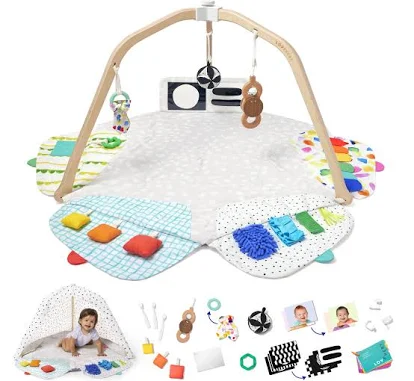
4. Lovevery The Play Gym
Lovevery’s Play Gym is the pick for a family who wants a gym with toys designed around early development, rather than a music-and-lights gym. It suits a baby from the newborn weeks, and it works well as a gift or a keep-for-the-next-baby purchase because it is built around a stage rather than a character.
Do not buy it expecting cushioning. It is a gym, so the same stop point applies as for the Fisher-Price gym: put it away once your baby is rolling and pushing up on hands and knees, around six months. Skip it if your floors are hard and you need cushioning, if the budget is tight, or if you only want something to hang a few toys from for a few months. In those cases, the Fisher-Price gym or a foam mat is the better use of money.
- Toy-led rather than screen-and-music-led, which suits parents who want a quieter play space.
- A gym, so it gives no cushioning on tile or timber.
- Usable from the first weeks, but the useful window is short, so it only makes sense if you value the design or plan to reuse it.
- Check the listing for the mat’s dimensions and what the toys are made from.
Lovevery The Play Gym
Fit details to confirm on the listing
We have not printed manufacturer dimensions or weight limits here, because sizes vary by listing and we cannot confirm one figure per product. Find these before you buy:
- Age range: use gyms from birth to about six months. Use foam floor mats from around six months, once baby is rolling, sitting and crawling.
- Dimensions: length and width in cm, so you can measure your floor.
- Thickness: in mm, and whether it is XPE or PE foam.
- Weight limit: if the manufacturer states one, note it, especially if you want the mat to last into toddlerhood.
- Warranty and care: any stated warranty, and the cleaning instructions.
Safety basics, whichever you choose
- Toys on a gym should meet AS/NZS ISO 8124, the Australian toy standard. It addresses small parts, sharp edges and mechanical hazards.
- Stop using a gym once baby is rolling or pushing up on hands and knees, around six months, as hanging toys become something to pull down.
- Check foam mats regularly for torn or crumbling edges, especially once baby is mouthing everything.
- Always supervise. A play mat is for awake time only.
Baby mats side by side
| Product | Brand | Approx RRP | Key features | Best for |
|---|---|---|---|---|
| Baby Care Play Mat #1 | Baby Care | See live card; varies by size | Large foam floor mat; confirm size and thickness on the listing | Rolling and crawling on hard floors without defaulting to a premium spend |
| Fisher-Price Deluxe Kick ‘n Play Piano Gym Budget | Fisher-Price | See live card | Soft mat, toy arch, kick piano with lights and music | A first purchase for birth to about six months |
| Parklon Pure Soft Mat Premium | Parklon | See live card; varies by size | Large foam floor mat in several sizes; confirm foam type and thickness | Open-plan homes with tile or timber floors and a baby aged six months or more |
| Lovevery The Play Gym | Lovevery | See live card | Toy-led gym, newborn-friendly, no floor cushioning | Families who want a quieter, stage-based gym and plan to reuse it |
We’ve reviewed 10 play mats in total — compare the full list before you decide.
Common baby mat questions, answered
How do I clean and deodorise a foam baby mat?
Wipe it with a damp cloth and mild soapy water, then dry it fully before folding or storing. Avoid bleach and strong solvents, which can damage foam, and check the manufacturer’s care instructions first. For a new-mat smell, air it in a well-ventilated room for a few days before use.
Is a rug enough instead of a foam mat?
For a young baby lying on their back, often yes. A rug gives some padding and warmth. Once your baby is rolling and crawling on tile or timber, a rug is thinner than a foam mat and can slide, so foam gives more cushioning. A rug with a non-slip underlay is a reasonable halfway option.
Can I use a foam mat on underfloor heating?
Check the manufacturer’s instructions before you do. Polyethylene foam can soften with heat, and a mat traps warmth against the floor. If the instructions do not mention underfloor heating, ask the brand directly rather than assuming it is fine.
When should I stop using a play gym?
Once your baby is rolling or pushing up on hands and knees, around six months. At that point the hanging toys become something to pull down, and a foam floor mat is the better fit.
Spend $200+ on a foam mat only if your floors are hard and your baby is rolling or crawling, from around six months. If your floors are carpeted or your baby is younger, a cheaper foam mat does the same job. For most Australian families, the best order is a gym first and a big foam mat second. Start with the Fisher-Price Deluxe Kick ‘n Play Piano Gym for the first six months, then move to the Baby Care Play Mat once your baby is rolling and crawling. Choose the Parklon Pure Soft Mat only if your floors are hard, your space is large and you want a mat for a sibling or toddler too. If you would rather have a quieter, toy-led gym, Lovevery The Play Gym is the alternative, but it will not cushion a fall.
Where to buy these picks
✓ Verified prices are checked live at the retailer. Otherwise we show the approximate RRP (an indicative recommended price, not a live retailer price), or “price pending” where we don’t have one.
Baby Care Play Mat
★ Best overall
Lovevery The Play Gym
Best premium first year
Fisher-Price Deluxe Kick 'n Play Piano Gym
Parklon Pure Soft Mat
The shortlist, in your inbox
New winners, price drops and recalls worth knowing.