

Best Kids Play Kitchen Australia 2026: Kmart vs KidKraft vs Wooden Options
There’s a particular kind of scroll-fatigue that hits around a third birthday or the run-up to Christmas: forty tabs open, three of them claiming to be “the best” play kitchen, and none of them telling you whether the timber one is actually sturdier than the plastic one your toddler will climb on regardless. Play kitchens are one of the few toys that genuinely earn their real estate in a lounge room, because open-ended pretend play (stirring, serving, pouring, negotiating whose turn it is with the wooden carrot) does more for language and imagination than almost anything with a screen or a battery.
The catch is that “play kitchen” now spans a roughly $80 flat-pack from a discount chain right up to a $400-plus European-style wooden set with a chalkboard and a working light-up hob. Both can be the right answer, depending on how many kids will use it, how long you need it to last, and whether it’s going in a shared playroom or a share house lounge with limited floor space. This guide compares the actual models Australian parents are searching for side by side, with honest trade-offs rather than a ranked list of the same five products everyone else copies.
What to look for in a kids play kitchen
Play kitchens all look similar in a thumbnail. The differences that actually matter show up once it’s assembled on your floor and being climbed on daily for the next two to four years.
- Stability when a toddler leans on it: a two-year-old will use the benchtop to pull themselves up, not just play at it. Check the base width and whether it needs to be anchored to a wall.
- Compliance with the relevant Australian Standard: toys sold in Australia should meet AS/NZS ISO 8124, which covers mechanical and physical safety including small parts, sharp edges and choking hazards for the stated age range.
- Assembly reality, not the box photo: wooden kitchens with dozens of panels can take well over an hour with two adults and an Allen key. Read assembly reviews, not just the finished-product shots.
- Footprint versus real estate: measure your actual floor space before falling for a photo of a huge kitchen island. Corner and compact models exist for a reason.
- Accessories included versus sold separately: some kitchens ship with pots, pans and play food, others need a separate accessory set, which changes the real total cost.
- Finish and material: painted MDF wooden kitchens generally outlast printed plastic panels in high-traffic households and photograph better for handing down, but plastic is lighter to move and typically cheaper to replace if damaged.
The best kids play kitchens in Australia for 2026
These are the specific, current models worth comparing, spanning the discount, mid-range and premium wooden tiers.
1. KidKraft Vintage Kitchen
KidKraft has been making wooden play kitchens for the US and Australian market for years, and the Vintage Kitchen remains the benchmark most other wooden sets get compared to. It has a retro fridge and oven aesthetic, a knob that clicks for pretend cooking sounds, and enough bench and storage space that two kids can genuinely play side by side rather than fighting over one stovetop.
Expect an approx. RRP in the vicinity of $250 to $300, which sits it firmly in mid-to-premium territory for a wooden kitchen rather than the true budget tier.
- Sturdy painted MDF construction that has held up well across reviews from multi-child households
- Realistic vintage styling that suits a shared playroom rather than looking like a toy in a lounge corner
- Assembly is genuinely long: budget an afternoon and two people
- No play food or cookware included, so factor in an accessory set

KidKraft Vintage Kitchen
2. Anko Wooden Play Kitchen
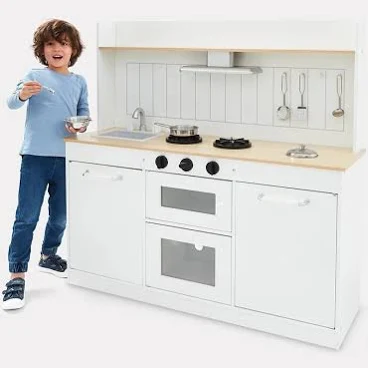
Anko is the house brand behind a lot of the wooden play kitchens spotted in Australian playrooms, and it’s the honest answer for a family who wants the timber look and feel without the KidKraft price tag. It’s simpler in styling with fewer bells and whistles, but it covers the fundamentals: a stovetop, oven door, sink and some storage.
Approx. RRP typically sits around $80 to $120 depending on the specific design available at the time, which makes it one of the more accessible entry points into a full wooden kitchen rather than a plastic one.
- Genuine timber construction at a price closer to plastic alternatives
- Compact enough for smaller playrooms and apartments
- Fewer interactive features (no lights, sounds or ice-maker style extras)
- Panel quality and finish are a step below the premium wooden brands, which shows over years of heavy use
Anko Wooden Play Kitchen
3. Little Tikes Cook ‘n Grow Kitchen
Little Tikes has built its reputation on tough, chunky plastic that survives being climbed on, dragged across tiles and left out in a Queensland carport. The Cook ‘n Grow Kitchen is the pick for a family who wants durability over aesthetics, or who has a toddler still in the throwing-things phase where a timber panel is a genuine risk.
It’s designed to grow with a child, with a section that converts as they get older, and it’s noticeably lighter to move between rooms than any wooden option. Approx. RRP sits around $150 to $180.
- Rotomoulded plastic construction that shrugs off drops and knocks better than painted MDF
- Lighter and easier to relocate for a shared or smaller living space
- Bright, primary-colour styling reads as more “toy” than “furniture”, which some parents love and others try to hide behind a couch
- Fewer premium features like real timber knobs or a chalkboard surface
Little Tikes Cook 'n Grow Kitchen
4. Tikk Tokk Little Chef Kitchen
Tikk Tokk is an Australian-designed wooden furniture and toy brand, and its Little Chef range is aimed squarely at parents who want a genuinely premium, furniture-grade piece rather than something that reads as plastic-adjacent once the paint scuffs. Expect solid timber elements, a considered Scandinavian-leaning colour palette, and a build quality intended to be handed down rather than replaced.
This is the splurge tier: approx. RRP generally runs from $350 up to $450 depending on the specific configuration and accessories bundled in.
- Furniture-grade finish that suits an open-plan living space, not just a playroom
- Designed and largely sourced with Australian households in mind, including compact footprint options
- Price puts it well above the KidKraft and Anko options, which only makes sense if longevity and aesthetics matter to you specifically
- Accessory sets (cookware, food) are typically sold separately again
Tikk Tokk Little Chef Kitchen
5. KidKraft Uptown Espresso Kitchen
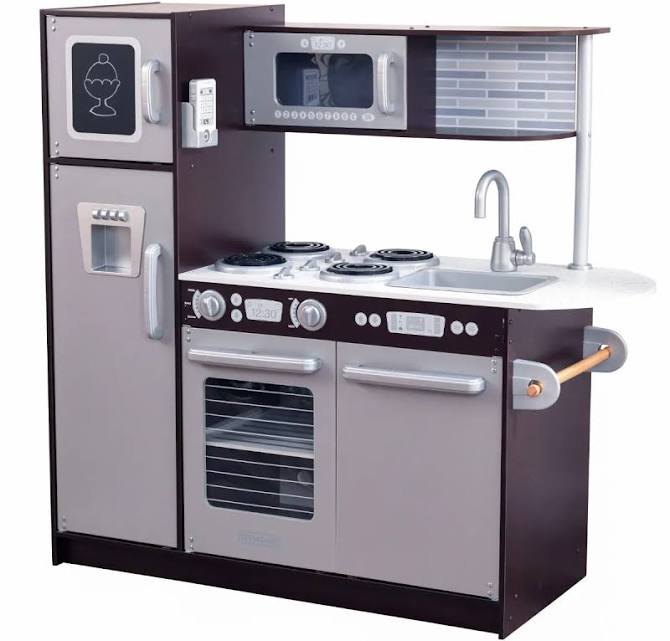
The Uptown Espresso is KidKraft’s darker, more contemporary-styled sibling to the Vintage Kitchen, and it’s worth a look if you want the same build quality but a colour scheme that blends into a modern kitchen or living room rather than standing out as brightly coloured. It has a similar footprint and feature set, with an ice dispenser detail and a more grown-up espresso-toned finish.
Approx. RRP is comparable to the Vintage model, generally around $260 to $320.
- Same trusted KidKraft build quality with a more neutral, adult-friendly colour palette
- Good middle ground between the Anko budget option and the Tikk Tokk premium tier
- Still a long assembly job, and still no included play food
- Slightly less “fun” primary colour appeal for kids who prefer bright, obviously toy-like design
KidKraft Uptown Espresso Kitchen
leading retailers vs KidKraft vs wooden: how the price tiers actually differ
The question isn’t really “which brand is best”, it’s which price tier matches how hard this thing is about to be used.
The budget tier (approx. $80 to $150)
This is where the Anko wooden kitchen and similarly priced plastic sets sit. You’re trading some finish quality and feature count for a genuinely low entry price, which makes sense for a first kitchen for a two-year-old, a smaller apartment, or a family who isn’t sure yet whether pretend-kitchen play will hold this particular child’s attention.
The mid-range tier (approx. $150 to $320)
KidKraft’s core range and the Little Tikes Cook ‘n Grow sit here. This is the sweet spot for most families: enough build quality and features to survive a sibling or two, without paying premium furniture prices for something that will get sticky texta on it within a fortnight regardless.
The premium tier (approx. $350-plus)
Tikk Tokk and similarly positioned Australian wooden brands live here. It only makes sense if you genuinely want a piece that could be photographed for a home styling account, plan to hand it down to younger siblings or pass it on, and have the floor space to give it a permanent, furniture-like spot rather than shuffling it around.
- If storage space is tight, prioritise footprint and weight over styling
- If this is for a shared playroom used by multiple ages, mid-range wooden usually wins on longevity per dollar
- If a toddler still mouths and throws toys, plastic is the safer near-term choice regardless of budget
- If it’s a one-off big-ticket gift for Christmas or a milestone birthday, the premium wooden tier earns its price through resale and hand-down value
| Product | Brand | Approx RRP | Key features | Best for |
|---|---|---|---|---|
| KidKraft Vintage Kitchen #1 | KidKraft | approx. $250 to $300 | Retro styling, clicking knobs, generous bench space | Shared playrooms, families wanting the trusted mid-premium option |
| Anko Wooden Play Kitchen Budget | Anko | approx. $80 to $120 | Genuine timber build, compact footprint | First kitchens, smaller spaces, tighter budgets |
| Little Tikes Cook ‘n Grow Kitchen | Little Tikes | approx. $150 to $180 | Rotomoulded plastic, grows with the child, lightweight | Toddlers still in a throwing/climbing phase, families who move it around often |
| Tikk Tokk Little Chef Kitchen Premium | Tikk Tokk | approx. $350 to $450 | Furniture-grade timber, Australian design, hand-down build quality | Families wanting a piece that doubles as home decor and lasts through siblings |
| KidKraft Uptown Espresso Kitchen | KidKraft | approx. $260 to $320 | Contemporary espresso finish, ice dispenser detail | Parents wanting KidKraft quality in a more neutral colour palette |
Want to see how these stack up? We’ve reviewed 28 kids toys in total.
mum. Approved: our top 3 for 2026
The build quality, bench space and trusted track record justify sitting above the budget tier without tipping into premium pricing.
Real timber and the core kitchen features for a fraction of the mid-range price.
Furniture-grade Australian design that earns its price if longevity and looks both matter to you.
Frequently asked questions
What age is a play kitchen actually suitable for?
Most play kitchens on the Australian market are designed for children from around eighteen months to two years through to roughly six or seven, though smaller-handed toddlers may need help with sturdier oven doors or knobs at the younger end. Always check the manufacturer’s stated age range on the packaging, which reflects testing against AS/NZS ISO 8124.
Is a wooden play kitchen worth the extra cost over plastic?
It depends on how the kitchen will be used. Wooden kitchens generally offer a more solid, furniture-like feel and tend to hold up better to years of daily play and multiple children, which is where the extra cost pays off. Plastic options like the Little Tikes range are lighter, cheaper to replace if damaged, and often better suited to younger toddlers still in a throwing or climbing phase.
Do play kitchens need to be anchored to the wall?
Many wooden and taller plastic play kitchens can tip if a toddler pulls up on the bench or climbs the shelving, so it’s worth checking the manufacturer’s instructions for anti-tip fixings and using them, particularly in the first year or two when a child is heaviest relative to the unit’s base.
What accessories do I actually need to buy separately?
Most play kitchens, including the KidKraft and Tikk Tokk ranges, ship as the kitchen structure only, without pots, pans, cutlery or play food. Budget for a separate wooden or plastic accessory set, or look at combining birthday and Christmas gifts so the kitchen isn’t sitting empty on day one.
How much floor space does a play kitchen realistically need?
Compact models like the Anko wooden kitchen can fit in a corner of a bedroom or living area, while larger sets like the KidKraft Vintage Kitchen or Tikk Tokk Little Chef benefit from a dedicated playroom spot, ideally with a little clearance on at least two sides so more than one child can play at once.
If we had to choose one, the KidKraft Vintage Kitchen is our 2026 pick for most Australian families, striking the right balance between build quality, features and price without tipping into premium territory. On a tighter budget, the Anko Wooden Play Kitchen won’t let you down, and if you want a genuine furniture-grade splurge that could be handed down through siblings, the Tikk Tokk Little Chef Kitchen is worth the extra outlay.
Where to buy these picks
✓ Verified prices are checked live at the retailer. Otherwise we show the approximate RRP (an indicative recommended price, not a live retailer price), or “price pending” where we don’t have one.
KidKraft Vintage Kitchen
★ Best for shared playrooms
KidKraft Uptown Espresso Kitchen
Best for small spaces
Anko Wooden Play Kitchen
Best value first kitchen
Little Tikes Cook 'n Grow Kitchen
Best for tough toddlers
Tikk Tokk Little Chef Kitchen
Best heirloom quality
The shortlist, in your inbox
New winners, price drops and recalls worth knowing.