Baby Activity Centre vs Jumper vs Walker: What’s Safe for Australian Babies
The choice usually arrives at about the four-month mark. Your baby has outgrown lying on a blanket, and you want somewhere for them to play, in sight, while you get a few things done. Then you open a search and find jumpers, seated walkers, play gyms, bouncers and “activity centres” that seem to be all of those at once.
This guide sorts them out. A baby activity centre can mean three quite different things, and they do not carry the same risk or suit the same age. We have not used any of these products ourselves. What follows comes from specs, standards and manufacturer age and weight limits.
The short version: a good baby activity mat is the lowest-risk starting point, a stationary jumper is an optional extra for short sessions once your baby is ready, and a wheeled seated walker is the one to skip. One rule covers every product below: mats, jumpers and push walkers all need an adult in the room. None of them is a place to leave a baby while you step away.
Do not buy a jumper at all if your baby:
- Is not yet holding their head steady
- Is already pulling to stand (a jumper is no longer the right stage)
- Is over the maker’s weight limit
How to read the box: the play gym is our overall pick because it works from birth and carries the least risk. The Jumperoo is labelled separately as the best jumper because it is the clearest example of a true stationary activity centre. It suits only babies in the later window described below, and it is an add-on to floor play, not a first purchase.
Jumper, walker or mat: what each one actually is
Retailers lump these together, but they work differently and suit different ages. Knowing which type you are shopping for is the biggest safety decision in this category.
The baby activity mat (play gym)
This is a padded mat with an overhead arch of hanging toys. Your baby lies on it, bats at the toys, then rolls and does tummy time. It works from birth and nothing holds your baby upright, so it has the fewest ways to go wrong. A baby activity mat is also the type you will keep using longest, because it supports tummy time and floor play well beyond the newborn weeks.
The stationary activity centre or jumper
A fixed frame holds a seat on springs or an elastic strap, surrounded by toys. Your baby bounces, spins and plays in place. It does not travel, which is the main reason it is considered lower risk than a wheeled walker. Manufacturers commonly state a minimum age of about six months, because your baby needs good head and neck control and must be able to touch the floor with their feet. Always read the age and weight limits for your specific model.
The walker
Here the word covers two very different products:
- Seated, wheeled walkers let a baby roll around on the floor in a seat. They put babies in reach of stairs, hot surfaces and cords before they can get out of trouble. Child-safety organisations in Australia have raised concerns about them, so check the current advice from Kidsafe and Product Safety Australia. We do not recommend one.
- Push-along walkers are a toy your baby holds and pushes once they can pull themselves to standing. They are a different category and need supervision, clear floors and closed stair gates.
The safety standards that apply
Play mats, gyms and push toys are generally treated as toys, and toy safety standards such as AS/NZS ISO 8124 cover hazards like small parts and mechanical strength. We cannot confirm that one standard covers every product type here, so look for the maker’s compliance statement on the box or product page. For stationary jumpers the rules are less clear-cut than for cots or car seats, so rely on the manufacturer’s stated age and weight range and look at Product Safety Australia for current guidance. We do not claim a specific standard number for jumpers.
What to look for before you buy
Whichever type you land on, this checklist cuts the options down fast.
- Age and weight limits: stick to the manufacturer’s range. A jumper used for a baby without solid head control is the commonest misuse.
- Stability: a wide, non-wheeled base that will not tip when a determined baby leans out. Check the footprint listed on the product page.
- Floor space: a jumper needs a clear area around it, which matters in a small flat.
- Washable fabric: seats and mats that collect milk and dribble should come off or be wipeable. Read the care label.
- Toy attachments: secure toys with no small detachable parts, and hanging toys with short cords or ribbons. Gyms usually carry a warning about when to stop using the overhead toys, so read it.
- Batteries: lights and music run on batteries, so find out which type and how many.
- How long it will last: a mat that covers the first year is better value than a jumper used for a few months.
How long in a jumper is too long?
Follow the manufacturer’s session-length guidance and keep jumper time short. Jumpers should not replace floor time, which is where babies build the strength for rolling, crawling and sitting. If you have any concern about your baby’s hips or development, ask your child health nurse or GP before buying one.
The picks, with the honest trade-offs
1. Fisher-Price Deluxe Kick ‘n Play Piano Gym
This is our overall pick, and for a first baby it is likely the smartest buy. It combines a padded mat, an overhead arch of toys and a kick-activated piano with lights and music. It is made for use from birth, so it covers the longest stretch of any product here. Because nothing holds your baby upright, you avoid the head-control and hip questions that come with jumpers. It sits in the budget-friendly band for a branded gym.
Check the manual for your version’s age range and for the point at which to stop using the hanging toys. Play gyms typically carry a warning once a baby can push up on hands and knees, and we have not confirmed the exact wording for this model. Never leave your baby unattended on it.
- Made for use from birth, so it starts working in the newborn weeks
- Piano is played by kicking, which gives early cause and effect
- Flat mat suits tummy time as well as lying on the back
- Lights and music need batteries, so keep spares on hand
- Plastic arch toys are standard fare, not a design statement
Fisher-Price Deluxe Kick 'n Play Piano Gym
2. Fisher-Price Rainforest Jumperoo
If you want a proper stationary baby activity centre, this is the best-known option. It has a spinning, bouncing seat, a rainforest-themed ring of toys, lights and music, and a frame that stays put. It is meant for a narrow window: a baby with good head control who is not yet pulling to stand, and who is within the weight limit. The manual lists the exact age and weight limits for your version, so read them before you buy. It sits in the mid-range price band.
The trade-offs apply to every jumper. It is bulky, it takes batteries, and it is not a replacement for floor play. Set the seat so your baby’s feet are flat on the floor, and keep an adult in the room for every session.
- Stationary frame, so your baby cannot travel towards hazards
- Seat spins, so your baby can reach different toys without being moved
- Large footprint, so measure the space before you order
- Needs batteries for lights and music
- Outgrown quickly once your baby starts pulling to stand
Fisher-Price Rainforest Jumperoo
3. Lovevery Play Gym
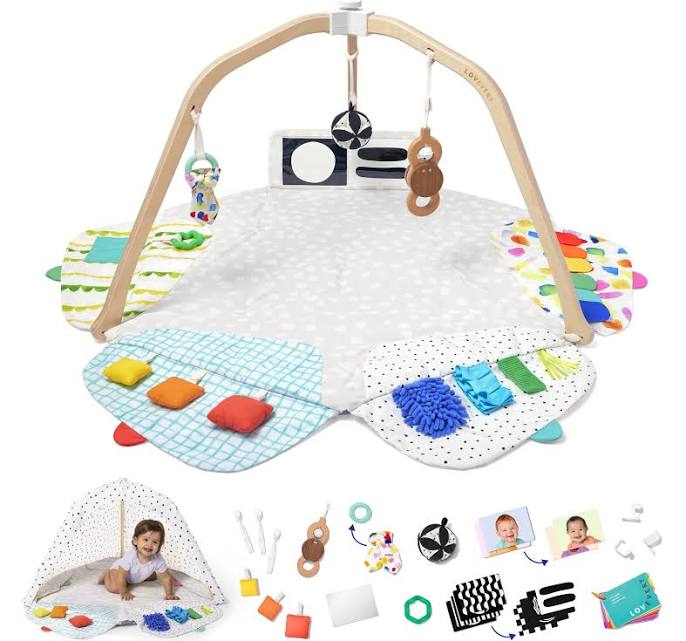
The Lovevery Play Gym is a wooden-frame play gym with a fabric mat and a set of toys designed to be introduced in stages as your baby develops. It is aimed at the first year, and the idea is that the setup changes as your baby moves from watching to reaching to rolling. Check the Australian product page for the stage count, the full contents and the age range before buying. It sits in the premium price band.
The price is the obvious downside. You are also buying into a developmental-stage approach, and some parents will find a cheaper mat does the same job. The frame is wood rather than a plastic arch, and the toys are simpler than a lights-and-music gym.
- Wooden frame with a fabric mat, rather than a plastic arch and printed foam
- Toys are introduced across several stages of the first year
- Mat is fabric, so read the care label for how to wash it
- Premium price compared with a standard baby activity mat
- No electronic music or lights, which suits parents who want a quieter setup
Lovevery Play Gym
4. VTech Sit-to-Stand Learning Walker
Once your baby starts pulling up on furniture, this push-along walker is the safer answer to “should I buy a walker?”. It has a play panel your baby can use while sitting, then stands behind to push once they are confident. It is a push toy, not a seated walker, so your baby is on their own two feet. VTech sells it from around six months for the seated play, but check the Australian spec page for the age range. The push-walking part only becomes useful once your baby can pull to stand. It sits in the budget-friendly band.
Wheeled toys still need supervision, and you will want stair gates closed and slippery floors considered. The maker describes adjustable wheel resistance, so look for that setting in the manual before your baby starts to push.
- Baby stays on their feet, supporting their own weight
- Seated play panel can be used before your baby can stand
- Wheel resistance is adjustable, which helps on slippery floors
- Needs a clear route and closed gates at stairs
- The push-along stage only starts once your baby can pull to stand
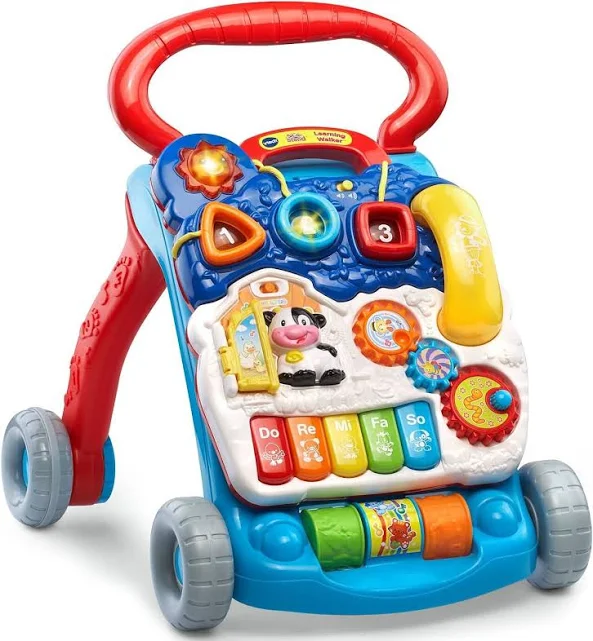
VTech Sit-to-Stand Learning Walker
What to skip
- Seated, wheeled walkers: for the reasons above, we do not recommend one.
- Jumpers below the maker’s minimum age: the age limits exist for a reason.
- Second-hand frames without a manual: you cannot check age or weight limits, or for missing parts.
- Door-frame hanging jumpers: they depend on the doorframe and clamp, and are a step further from a stable frame.
The four side by side
| Product | Brand | Approx RRP | Key features | Best for |
|---|---|---|---|---|
| Deluxe Kick ‘n Play Piano Gym #1 | Fisher-Price | Budget-friendly band | Padded mat, toy arch, kick piano with lights and music, made for use from birth | Newborns and first-time parents |
| Rainforest Jumperoo | Fisher-Price | Mid-range band | Stationary frame, spinning bouncing seat, ring of toys, lights and music | Babies with good head control who are not yet pulling to stand |
| Lovevery Play Gym Premium | Lovevery | Premium band | Wooden frame, fabric mat, toys introduced in stages | Parents wanting a low-clutter gym for the first year |
| Sit-to-Stand Learning Walker | VTech | Budget-friendly band | Push-along walker with seated play panel, adjustable wheel resistance | Babies from around 6 months for seated play, then pulling to stand |
We’ve reviewed 9 walkers & activity centres in total — compare the full list before you decide.
Questions parents ask about baby activity centres
How do I clean a play mat or jumper?
Follow the care label and manual for your model. Fabric seats and mats are often removable or wipeable, and a damp cloth with mild soapy water is the usual approach for hard surfaces. Let everything dry fully, because babies mouth the toys.
Is a second-hand jumper or gym safe?
Only if you can confirm the age and weight limits, the frame is stable with nothing cracked or missing, and the product has not been recalled. Search the Product Safety Australia recalls list for the brand and model before you say yes.
Can my baby nap in a jumper or on a play mat?
No. If your baby falls asleep, move them to their cot or bassinet for safe sleep.
Can I leave my baby in one while I’m in another room?
No. Mats, jumpers and push walkers all need an adult in the room, because a baby can slump, tip a toy or reach something hazardous within seconds.
Start with a mat. The Fisher-Price Deluxe Kick ‘n Play Piano Gym is our overall pick because it works from birth and avoids the upright-use questions that come with jumpers. The Lovevery Play Gym is the premium alternative if you want a wooden frame and a staged toy set for the first year. Add the Fisher-Price Rainforest Jumperoo, our best jumper, only if your baby has good head control, is within the maker’s weight limit and is not yet pulling to stand, and use it in short, supervised sessions. Keep the VTech Sit-to-Stand Learning Walker in mind for when your baby starts pulling up. Skip the seated, wheeled walker entirely.
Where to buy these picks
✓ Verified prices are checked live at the retailer. Otherwise we show the approximate RRP (an indicative recommended price, not a live retailer price), or “price pending” where we don’t have one.
Fisher-Price Deluxe Kick 'n Play Piano Gym
★ Best for newborns
VTech Sit-to-Stand Learning Walker
Best for growing with baby
Lovevery Play Gym
Best for first year
Fisher-Price Rainforest Jumperoo
Best for bouncing babies
Keep reading
The shortlist, in your inbox
New winners, price drops and recalls worth knowing.