
Are Glass Baby Bottles Actually Safer Than Plastic? Three Worth Buying in Australia
The decision usually arrives at 3am with a warm bottle in one hand and a news article about microplastics on your phone in the other. Glass looks like the clean answer. It also looks like something that will end up in pieces on the tiles when you are running on four hours of sleep and a baby is screaming for the next feed.
Both instincts are reasonable. Glass baby bottles are a genuinely good option, but they come with trade-offs that rarely make it into the product blurb: weight, childcare rules, and teat compatibility. This guide covers three glass baby bottles currently sold in Australia, what each is good at, and where it will annoy you.
We have not tested these bottles. This guide is based on manufacturer specifications, published product information and design trade-offs, so you can shortlist quickly and ignore the noise.
Are glass bottles actually safer than plastic?
Glass removes some worries and leaves others untouched. It is not a magic upgrade, and it is worth knowing exactly what you are buying.
What glass genuinely fixes
- No plastic shedding. Some laboratory research has found plastic bottles can shed microplastic particles, particularly with hot water. The health significance for babies is not established, but glass sidesteps the question entirely.
- No scratching or clouding. Plastic picks up scuffs from brushes and steriliser cycles, which can harbour residue. Glass stays smooth.
- No staining or smell. Expressed baby milk, formula and the odd spilt puree do not leave a lingering film or sour smell on glass.
- Sterilising is simple. Glass copes with steam, boiling and dishwasher heat, which matters if reflux means you are washing bottles constantly.
What glass does not fix
- The teat is still silicone. Teats wear out and need replacing regularly, whatever the bottle is made of.
- BPA is no longer the main differentiator. Most baby bottles sold in Australia are now BPA-free, so a plastic bottle labelled BPA-free is not a red flag.
- It is heavier and breakable. That matters in the bag, in the car, or when a toddler is learning to throw.
- Thermal shock is a risk. Do not pour boiling water into a cold bottle or move a hot bottle straight into cold water. Let it come down gradually.
Whichever bottle you choose, look for clear age guidance on the pack, the maker’s sterilising instructions, and a teat flow rate that suits your baby’s age and feeding pace.
What to look for in a glass baby bottle
These are the criteria that matter once you account for tired hands, reflux worries and a bag you are already overpacking.
- Protective sleeve or silicone coating: a sleeve adds grip and may cushion knocks, but it does not make glass unbreakable. It is still the most useful feature on a breakable bottle.
- Number of parts: every vent, insert and ring is another thing to scrub. If mess and cleaning fatigue are your main worry, fewer parts wins.
- Anti-colic venting: designed to reduce the air a baby swallows during a feed. Vent systems add cleaning steps, so decide how much of a trade you want.
- Teat shape and flow rate: matters most for combi-feeding. A teat shaped like the breast may ease switching between breast and bottle, though no teat guarantees acceptance.
- Teat compatibility: do not mix brands. Teats and bottles are designed as pairs, so buying into one range keeps replacements simple.
- Capacity and weight: a 240 ml glass bottle is noticeably heavier than plastic once full. Check whether you can hold it comfortably one-handed during a night feed.
- Childcare rules: some childcare centres do not accept glass bottles. If you are returning to work, ask before you buy a full set.
- Growing-up options: around the 6-month solids stage, a range with sipper cup or spout conversion parts means the bottle keeps working for longer.
The three glass baby bottles worth buying
Glass baby bottles are a smaller category than plastic, and this guide covers only three of them. Price is described in relative terms below; live pricing sits on the comparison links.
Sizes and teat flow: what suits a newborn and a 6-month-old
- Newborn (birth to around 3 months): choose the smaller bottle, usually around 120 to 150 ml, with the slowest flow teat. A smaller glass bottle is also lighter in the hand.
- Around 6 months: a larger bottle of around 240 to 270 ml with a medium or faster flow teat, if your baby is moving through feeds quickly or fussing at the slow teat.
- Check each pack: capacities and the teat stage supplied vary between ranges and pack types, so confirm them on the maker’s product page before buying.
1. Philips Avent Natural Glass baby bottle
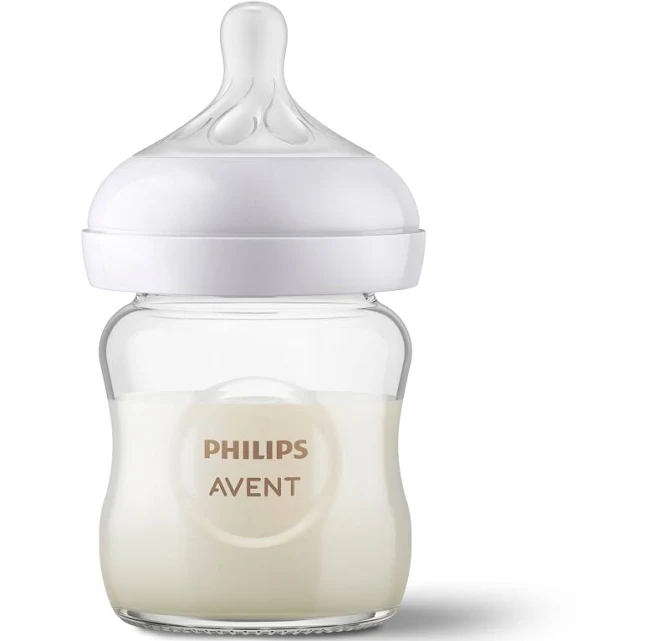
This is our pick for most families because the construction is simple and the range is broad. The bottle has a wide neck and a wide, breast-shaped Natural teat, and the anti-colic valve is built into the teat itself rather than being a separate insert, so there is no extra vent piece to wash. That leaves a bottle, teat, screw ring and cap. The Natural range is sold in smaller and larger glass sizes (commonly around 120 ml and 240 ml), and teats come in graded flow stages.
The newborn-friendly smaller bottle with a slow-flow teat suits early weeks, and the larger bottle with a faster-flow teat suits a baby approaching solids. The compromise is that the larger glass bottle is heavy once full, and the standard version has no sleeve, so a drop onto tiles is a real risk.
- Strength: only four main parts, so washing and sterilising is quick.
- Strength: wide, breast-shaped teat is designed to suit babies moving between breast and bottle, though no teat guarantees acceptance.
- Strength: teats at different flow stages come from the same range, so you can step up as your baby grows.
- Trade-off: heavier and more breakable than the plastic Avent equivalent, and there is no sleeve on the standard version.
- Trade-off: the venting is in the teat, so it is a lighter anti-colic approach than Dr. Brown’s internal vent system.
Philips Avent Natural Glass baby bottle
2. Dr. Brown’s Options+ Anti-Colic Glass bottle
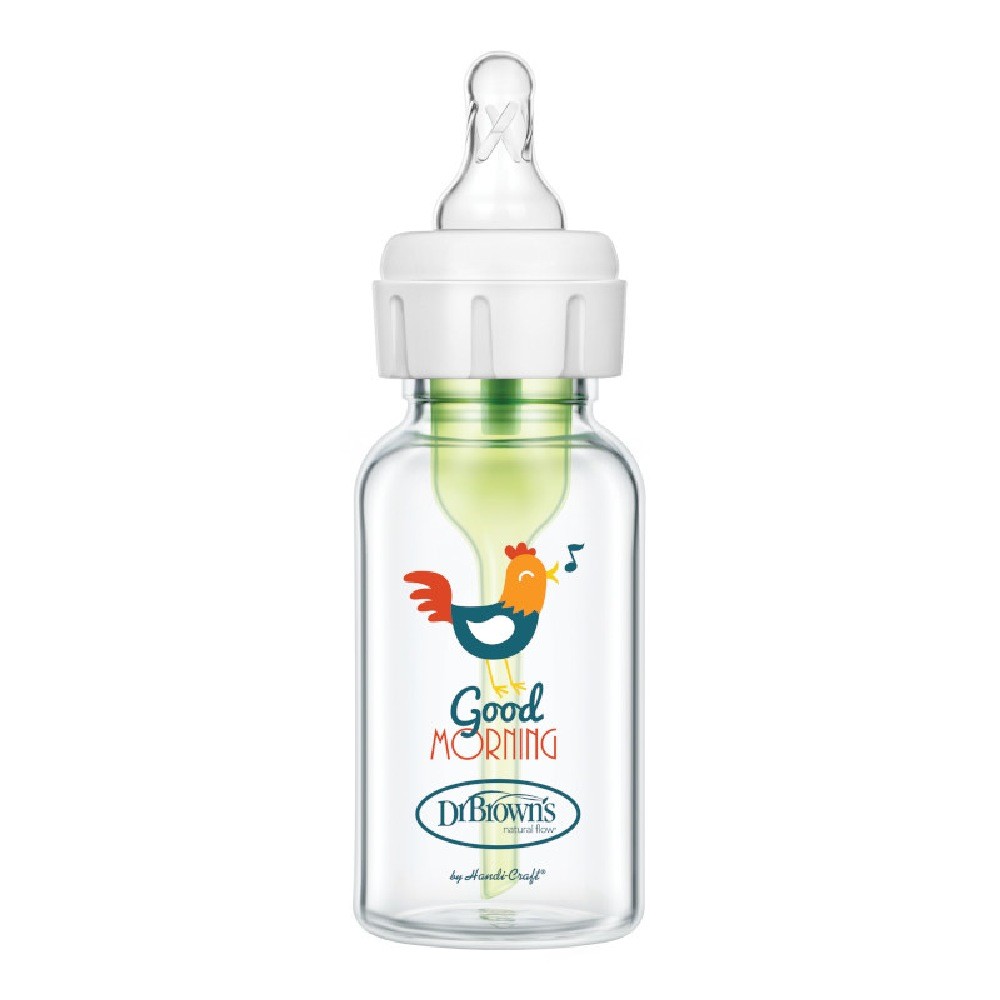
If wind, regurgitation and colic are your daily reality, this is the glass bottle to look at first, and it is why we have labelled it best for colic and reflux. Dr. Brown’s uses an internal vent: a thin vent insert sits inside the bottle and a small reservoir in the collar, so air travels through the insert to the back of the bottle rather than bubbling through the milk. The aim is to reduce air swallowed during the feed. With Options+, you can remove the insert once your baby is past the colic stage and use it as a standard bottle.
The catch is cleaning. The vent insert and reservoir add extra parts to wash and dry, and the narrow insert needs a small brush. It is worth it if your baby is unsettled during feeds, and less compelling if feeds are easy. The vent is designed to reduce air intake, not to treat reflux, so speak to your child health nurse or GP if you are worried.
- Strength: internal vent insert is designed to reduce air swallowed during feeds.
- Strength: the insert can be removed later, simplifying cleaning once wind settles.
- Strength: teats are graded by flow level, starting with a slow Level 1 for newborns, and the glass range comes in a smaller and a larger size (commonly around 150 ml and 270 ml). Check the pack for what is included.
- Trade-off: more parts to wash, which will wear on mess and cleaning fatigue.
- Trade-off: no sleeve on the standard glass version, and it is not proven to cure reflux.
Dr. Brown's Options+ Anti-Colic Glass bottle
3. Lifefactory Glass Baby Bottle
Lifefactory made its name with a glass bottle wrapped in a snug silicone sleeve, and that design is why it is the premium pick. The sleeve adds grip for small hands and may cushion everyday knocks, but it does not make the glass unbreakable. A bottle with a damaged sleeve or any chip in the glass should be retired. Lifefactory glass bottles come in a smaller size (around 120 ml) and a larger one (around 250 ml), so you can start small and move up.
It also keeps working past the newborn stage, with conversion caps for sipper cup and straw use, handy as solids start around six months. The downside is cost and weight. It is the most expensive of the three, and a full set adds up quickly.
- Strength: silicone sleeve adds grip and some cushioning against knocks.
- Strength: range includes caps and parts that extend use into toddler drinking.
- Strength: simple design with no separate vent insert, so it is generally easy to clean.
- Trade-off: the most expensive of the three, per bottle.
- Trade-off: still glass, so heavy in a nappy bag. Ask about childcare rules first.

Lifefactory Glass Baby Bottle
When not to buy glass
- Your childcare bans glass. Some centres do not accept it, and you will end up buying plastic anyway.
- Your baby or toddler throws things. Once bottles become projectiles, plastic is the safer choice.
- You travel or do day trips constantly. Weight and breakage risk add up in a bag that goes everywhere.
What to skip
- Mixing and matching teats across brands to save money. Poor fit leads to leaks and flow problems.
- Buying a full set up front. Start with two or three bottles and see how your baby feeds first.
- Chipped or cracked glass. Retire the bottle immediately. Do not keep using it.
- Unbranded glass bottles with unclear glass type or sterilising advice.
Glass baby bottles compared at a glance
| Product | Brand | Price position | Key features | Best for | Who it suits |
|---|---|---|---|---|---|
| Natural Glass #1 | Philips Avent | Mid-priced | Wide breast-shaped teat with built-in valve, few parts, range compatibility | Everyday feeding and combi-feeding | Newborns through to 6 months, parents who want quick cleaning |
| Options+ Anti-Colic Glass Colic and reflux | Dr. Brown’s | Mid-priced | Internal vent insert, removable once wind settles, graded teat flow levels | Gassy or unsettled babies | Newborns with wind or colic, parents happy to wash extra parts |
| Glass Baby Bottle Premium | Lifefactory | The most expensive of the three | Silicone sleeve, conversion caps for later stages | Extra grip and a longer-lasting bottle | Parents wanting one bottle that carries into the 6-month solids stage and beyond |
Not sure yet? Put all 26 bottles & teats we rate next to each other.
Common questions about glass baby bottles, answered
Which teat flow rate suits a newborn versus a 6-month-old?
Newborns generally start on the slowest flow, often labelled newborn or Level 1, which helps them pace feeds and reduces gulping. Around 6 months, many babies move to a medium or faster flow, but the age on the pack is only a guide. Signs to step up include very long feeds, frustration at the teat, or collapsing of the teat during sucking. Signs the flow is too fast include coughing, gulping or milk running from the corners of the mouth.
Can glass bottles go in the freezer for expressed milk?
Not every glass bottle is rated for the freezer, so check the maker’s instructions first. Milk expands as it freezes, so a full bottle can crack. If your bottle is rated for freezing, leave generous space at the top, cool the milk in the fridge first and never freeze a bottle with a chip. Many parents freeze expressed milk in storage bags or containers made for the purpose and transfer it to the bottle once thawed.
How many glass baby bottles should I buy?
Start with two or three, then add more once you know how your baby feeds. A fully breastfed baby who gets the occasional bottle needs fewer than a baby feeding mostly from the bottle. If you are returning to work and sending bottles to childcare, count the bottles needed for a full day, plus a spare so you are not washing mid-shift.
Can I heat baby milk in a glass bottle?
Glass tolerates warm water baths well, but avoid sudden temperature swings and never microwave baby milk, as it heats unevenly and can create hot spots. Always check the temperature on your wrist before feeding.
For most families, start with the Philips Avent Natural Glass baby bottle: it has few parts to wash, a wide breast-shaped teat for combi-feeding, and a range you can build around from newborn to solids. If your baby struggles with wind or colic, the Dr. Brown’s Options+ Anti-Colic Glass bottle is the better fit, provided you can live with the extra washing. If you want a sleeve for extra grip and a bottle that keeps being useful once solids begin, the Lifefactory Glass Baby Bottle is the one to splurge on. Whichever you pick, buy two or three first, check your childcare’s glass policy, and retire anything with a chip.
Where to buy these picks
✓ Verified prices are checked live at the retailer. Otherwise we show the approximate RRP (an indicative recommended price, not a live retailer price), or “price pending” where we don’t have one.
Philips Avent Natural Glass baby bottle
★ Best all-rounder
Dr. Brown's Options+ Anti-Colic Glass bottle
Best glass for colic
All 2 prices we track for this pick
- Baby Kingdom $16.79 checked 4 Oct 2026
- Baby Bunting $22.95 checked 6 Oct 2026
Lifefactory Glass Baby Bottle
Best premium glass
The shortlist, in your inbox
New winners, price drops and recalls worth knowing.