
Mindfulness for Kids in Australia: The Apps, Books and Tools Worth Trying
There is no single fix for the after-school meltdown, the Sunday night school dread, or the racing mind at bedtime, but there is a genuine and growing set of apps, books and tools built specifically for kids’ attention spans and big feelings, not adult mindfulness apps with cartoon graphics stuck on top.
The problem for a busy parent isn’t a lack of options, it’s sorting the handful that actually work from the hundreds of “calm down corner” products cluttering search results.
We’ve done the digging so you don’t have to open forty tabs between school pickup and dinner. Below is a short, honest list of real apps, books and tools Australian families use, what each one is genuinely good at, and where it falls short.
Why mindfulness for kids matters right now
Most parents aren’t chasing mindfulness for kids because of a wellness trend, they’re chasing it because the after-school witching hour, the Sunday night school dread, or a specific worry (a new sibling, a house move, a tricky friendship) has become a nightly negotiation. Meditation for kids isn’t about producing a silent, zen child. It’s about giving them a handful of concrete tools, a breath they can find, a word they can use, a five-minute script they recognise, so the big feeling passes without hijacking the whole evening.
As a general rule, and this is a broad pattern parents and educators widely report rather than a specific study we’ve reviewed ourselves, short, consistent, age-matched practice tends to help most with self-regulation and settling at bedtime. It is not a substitute for professional support if a child has an anxiety disorder, but as an everyday household tool, it earns its place next to the fish oil and the good pillow.
What to look for in a mindfulness tool for kids
- Age-matched session length: a five-year-old’s attention span runs to about two to five minutes; an eight to twelve-year-old can usually manage ten. A tool pitched at the wrong age gets abandoned within a week.
- No hidden ads or in-app nagging: some “free” kids’ apps push in-app purchases mid-session, which undoes the calm before it starts. Check reviews specifically for this.
- Screen-free options in the mix: books and card decks work at bedtime or in the car without adding another screen to the evening routine, and many child sleep specialists recommend winding down away from a device in the hour before sleep.
- A screen-time-aware choice for mixed-age households: Australian guidance recommends no screen time for children under two and limited recreational screen time for ages two to five, so if there’s a toddler in the house, lean on the screen-free books and card decks below rather than an app.
- Australian development or local relevance: apps built with Australian psychologists and educators tend to use language and pacing that matches how Australian classrooms already teach self-regulation.
- Transparent, ongoing cost: some tools are a one-off purchase, others are a recurring subscription. Know which one you’re signing up for before your child gets attached to it.
- Physical safety for younger siblings: card decks and small physical tools intended for children under three should be checked for age-appropriate labelling and choking-hazard warnings, since small cards and pieces can be a hazard for a toddler sibling.
The best mindfulness apps, books and tools for Australian kids
1. Smiling Mind app
Smiling Mind is a genuinely Australian-built option: developed by an Australian not-for-profit with input from psychologists and educators, and it’s free, with no ads and no in-app purchases at the time of writing. Programs are structured by age, from early years through primary and teens, with dedicated modules for sleep, focus and anxious moments.
The trade-off is that the interface is plain and a little clinical next to flashier commercial apps, so a very young or sensory-seeking child may need a parent to select the right program and sit through the first session with them.
- Free, Australian-developed, no ads or hidden purchases
- Structured programs by age and by specific need (sleep, focus, big feelings)
- Backed by psychologists rather than a wellness marketing team
- Plain design won’t wow a child used to bright, gamified apps
- Still requires screen time, which some families want to limit before bed
Smiling Mind app
2. Sitting Still Like a Frog by Eline Snel
First published in the Netherlands, Sitting Still Like a Frog went on to become an international bestseller and has been translated into more than twenty languages. Written by child therapist Eline Snel with a foreword from mindfulness pioneer Jon Kabat-Zinn, it pairs short chapters with guided audio meditations (via download or CD depending on edition), aimed roughly at ages five to twelve. Because it’s a physical book, it slots straight into a bedtime routine without adding another screen.
The language runs a touch more sophisticated than some competitors, so a parent will likely need to read and guide the exercises for children under seven rather than hand the book over solo. Pricing varies by edition and retailer, check the link below for current figures.
- No screen needed, works well as a bedtime replacement for a device
- Guided audio meditations included, not just text
- Written by a qualified child therapist, not a general wellness author
- Best suited to ages seven and up without heavy parent involvement
- Less visually engaging for reluctant readers than an illustrated card deck
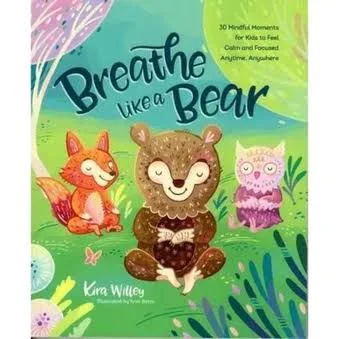
3. Breathe Like a Bear by Kira Willey
Where Sitting Still Like a Frog suits the primary years, Breathe Like a Bear is pitched squarely at little ones, roughly ages three to eight. It’s a collection of thirty short mindful moment scripts, each only a page or two, written to be read aloud by a parent or teacher rather than by the child. Each script is grouped by mood or moment, energetic, upset, tired, so a parent can flip straight to the one that matches what’s happening rather than reading the book start to finish.
Because each script is so brief, it’s genuinely useful for the two-minute window before a tantrum tips over, but older kids will outgrow it faster than a program like Smiling Mind that scales up with age. Pricing varies by retailer, check the link below for current figures.
- Very short scripts, ideal for the two to five minute window young kids can sustain
- No reading required from the child, a parent or teacher leads it
- Affordable one-off purchase, no subscription
- Outgrown faster than an app with age-tiered content
- Best as a spoken tool, not something a child uses independently
4. Moshi: Twilight Sleep and Mindfulness
Moshi is the premium pick here because it genuinely does more than the free options: calming stories, ambient soundscapes and short breathing exercises voiced by well-known narrators, designed specifically to wind a child down before sleep. Moshi doesn’t publish a strict minimum age, but most of its content is pitched at children roughly three and up; for babies and toddlers under two, Australian guidance recommends no screen time at all, so a screen-based sleep app isn’t the right fit for that age group regardless of how good the content is. It’s most popular with families of primary-school-aged kids who’ve struggled with a drawn-out bedtime routine.
The catch is the ongoing cost: it’s a subscription rather than a one-off purchase, and plan pricing (including any family bundle) is worth checking directly, since subscription apps tend to adjust pricing more often than a printed book. Families who prefer a one-off purchase over a recurring charge should weigh this against the free alternatives above before committing.
- Purpose-built for bedtime, not a general-purpose app repurposed for sleep
- Professionally produced audio, strong production value
- Family plans available for multiple children
- Recurring subscription cost rather than a one-off purchase
- Screen or audio device needed in the bedroom, which not every family wants
Moshi: Twilight Sleep and Mindfulness
5. Chill Panda (Nintendo Switch)
Chill Panda takes a completely different approach: it’s a game, not a meditation app, that uses the Joy-Con’s grip sensor to read a child’s breathing and heart rate cues, then guides them through calming activities like tending a garden or floating with a panda. It suits kids from about age six who respond better to a gamified goal than to being told to “sit still and breathe.”
It only works, of course, if a Nintendo Switch is already in the house, and it’s a game a busy household needs to actively hand a child rather than something that runs quietly in the background. If younger siblings are also around, keep in mind that Australian screen-time guidance recommends limiting recreational screen use for children aged two to five, so this is best treated as an activity for the school-aged child rather than a shared sibling session. Pricing for the digital download varies by platform, check the link below for current figures.
- Genuinely different mechanism, biofeedback rather than a guided script
- Well suited to kids who resist traditional “be still” meditation styles
- Requires an existing Nintendo Switch console
- Session length is set by gameplay, not always matched to a specific mood in the moment
- Screen-based, which some families want to avoid before bed
Chill Panda
6. Mindful Kids: 52 Activities Cards by Whitney Stewart
This illustrated card deck (Barefoot Books, illustrated by Mina Braun) is the tool most parents reach for mid-meltdown, precisely because it needs no screen, no login and no charging. Each card is a two to five minute activity, roughly suited to ages four and up, and the deck fits in a school bag, glovebox or nappy bag.
Because it’s a physical product with small cards, keep it out of reach of toddler siblings, and check the packaging is labelled age-appropriate and free of choking-hazard warnings if a younger child is likely to handle it unsupervised. Pricing varies by retailer, check the link below for current figures.
- Screen-free, portable, no charging or subscription required
- Quick activities suited to the exact moment a meltdown is building
- Illustrated and accessible for kids who don’t love reading full pages of text
- Cards can go missing over time, unlike a permanently installed app
- Some activities need space to move, less useful in a car or waiting room
| Product | Brand | Approx RRP | Key features | Best for |
|---|---|---|---|---|
| Smiling Mind app #1 | Smiling Mind | Free | Age-tiered programs, no ads, developed by Australian psychologists | Everyday use across all ages, families wanting zero ongoing cost |
| Sitting Still Like a Frog Budget | Eline Snel / Shambhala | Varies, check price | Guided audio meditations, screen-free bedtime option | Ages 7 to 12, families avoiding extra screen time |
| Breathe Like a Bear | Kira Willey | Varies, check price | Very short read-aloud scripts | Ages 3 to 8, quick in-the-moment resets |
| Moshi: Twilight Sleep and Mindfulness Premium | Moshi | Subscription, varies by plan | Bedtime stories, soundscapes, breathing exercises | Families overhauling a difficult bedtime routine |
| Chill Panda | Nintendo Switch | Varies, check price | Biofeedback gameplay via Joy-Con | Kids age 6+ who resist sit-still meditation |
| Mindful Kids: 52 Activities Cards | Barefoot Books | Varies, check price | Illustrated card deck, screen-free, portable | Ages 4+, on-the-go calm-down tool |
Not sure yet? Put all 6 parenting tips we rate next to each other.
The three we’d actually download
Free, Australian-built, and structured for every age from early years to teens.
A one-off purchase that replaces a screen at bedtime, written by a qualified therapist.
Worth the subscription if bedtime itself is the battle you’re trying to solve.
Mindfulness activities for kids you can start today, no purchase required
Not every family needs to buy anything to start. Several genuinely effective mindfulness activities for kids cost nothing and take less than five minutes:
- Glitter jar breathing: fill a clear jar or bottle with water, glue and glitter, shake it, and ask your child to breathe slowly until the glitter settles. The physical wait mirrors the emotional one.
- 5-4-3-2-1 grounding: name five things you can see, four you can hear, three you can touch, two you can smell, one you can taste. Excellent for the car ride home from a big day.
- Belly breathing with a toy: lie down with a stuffed toy on the tummy and watch it rise and fall with each breath, a simple visual for younger kids who can’t yet grasp “breathe deeply.”
- Mindful walking to school: notice three sounds, two smells and one colour along the route, turning a transition into a quiet check-in rather than a rushed handover.
- A shared gratitude jar: one line each night about something good that happened, read back together at the end of the week or month.
These cost nothing and pair well with any of the paid tools above, an app or book gives structure on the harder nights, and the free activities keep the habit ticking over the rest of the time.
If your child refuses every tool on this list
Some kids, especially strong-willed or sensory-sensitive ones, will refuse anything that sounds like “sit still and breathe,” no matter how good the app or book is. That’s normal, not a sign mindfulness doesn’t work for your child. Try folding a tiny version into something already happening, three slow breaths while buckling a car seat, naming one thing you can hear while waiting for toast, rather than introducing it as a separate named activity. If resistance is constant and paired with ongoing anxiety, sleep problems or a noticeable change in behaviour, it’s worth raising with your GP or a paediatric psychologist rather than persisting with apps and books alone.
Questions parents ask about mindfulness for kids
What age can kids realistically start mindfulness practice?
Most programs, including Smiling Mind, offer content from around age five, with simplified breathing and body-awareness exercises suitable even earlier when led by a parent. Under age three, keep it to physical cues like belly breathing with a toy rather than anything screen-based.
Is the Smiling Mind app really free, or does it push upgrades?
It is genuinely free, developed by an Australian not-for-profit rather than a commercial wellness company, with no ads and no in-app purchases at the time of writing. Always check current app store listings before downloading, as content can change.
How long should a mindfulness session be for a young child?
If a child resists even a short session, don’t force stillness, fold it into something already happening instead, like three slow breaths while brushing teeth or naming one sound on the walk to the letterbox. A tiny, consistent dose a child will actually do beats a longer session they come to associate with being told to sit down and be quiet.
Can mindfulness actually help with school anxiety?
Evidence from school-based trials, including several run in Australian primary schools, points to modest but genuine improvements in self-regulation and settling before tests or transitions. It works best as one part of a broader approach, not a replacement for professional support if anxiety is significant or persistent.
Do we need an app at all, or do books and cards work just as well?
For many families, a physical book or card deck works just as well, and better at bedtime since it avoids adding another screen. Apps add structure and progression as a child grows, which is useful, but they’re not essential to get real benefit from mindfulness at home.
Start with the Smiling Mind app because it costs nothing, was built by Australian psychologists, and grows with your child from the early years right through to the teens. If you’d rather keep screens out of the bedtime routine altogether, Sitting Still Like a Frog is the better first purchase and holds up for years of re-reading. Only stretch to a subscription like Moshi if bedtime specifically, not general regulation, is the problem you’re trying to solve.
Where to buy these picks
✓ Verified prices are checked live at the retailer. Otherwise we show the approximate RRP (an indicative recommended price, not a live retailer price), or “price pending” where we don’t have one.
Smiling Mind app
★ Best free everyday app
Sitting Still Like a Frog
Best screen free for ages 7 to 12
Breathe Like a Bear
Best quick calm down for little kids
Moshi: Twilight Sleep and Mindfulness
Best for tricky bedtimes
Chill Panda
Best for reluctant meditators
Mindful Kids: 52 Activities Cards
Best portable calm down cards
The shortlist, in your inbox
New winners, price drops and recalls worth knowing.