
Best Kids Toy Storage Australia 2026: $15 Hacks vs $500 Systems
There’s a particular kind of exhaustion that hits about an hour after a birthday party or Boxing Day, when the lounge room looks like a toy shop exploded and you’re standing on a stray Duplo brick in bare feet. You don’t just want the mess gone. You want your kid to actually rediscover what they own, to pull out a box of blocks or a puzzle and get properly absorbed in it, rather than everything becoming background clutter they walk past to ask for the tablet.
That’s really what good toy storage is doing, even though it looks like a simple furniture decision. Done well, it makes independent play more likely, because a toddler can see and reach what’s inside without your help. Done badly, it’s either a $15 fabric cube collapsing under the weight of ride-on toys, or a beautiful $500 shelving system that’s too tall, too tempting to climb, or simply overkill for a family who moves rentals every two years.
We’ve spent time pulling apart what’s actually sold in Australia right now, from the fold-flat cube hacks in the kids’ aisle to the furniture-grade systems parents save up for, to work out which is genuinely worth your money in 2026, and which is just a nicer-looking way to store the same amount of stuff.
What to actually look for in kids toy storage
Before you compare a single product, it helps to know what separates storage that survives a real Australian household from storage that looks great in the catalogue photo and then gets shoved in a corner within a month.
- Tip-over stability: any tall unit a toddler can climb is a genuine hazard in a home with a curious 1 to 4 year old, so check the manufacturer’s anchoring instructions and use them, in line with the relevant Australian Standard for furniture stability.
- Open vs closed storage: open bins and low shelves let a toddler choose and put back toys themselves, which is exactly what supports the screen-free, self-directed play most parents are chasing.
- Weight capacity per bin or drawer: a fabric cube rated for soft toys will sag and eventually tear under a box of wooden blocks or die-cast cars.
- Lid and hinge safety: old-style toy chests with unsupported heavy lids are a real finger-pinch and head-strike risk, so look for soft-close hinges or, better, no lid at all for the under-5 years age group.
- Room to grow: modular systems that let you add a drawer or bin later cost more upfront but often work out cheaper than replacing a fixed unit every developmental leap.
- Cleanability: wipeable plastic or laminate beats raw timber or unsealed fabric once texta, glitter and snack crumbs get involved, which they will.
$15 hacks vs $500 systems: what the price difference actually buys
What a $15 to $30 hack gets you
The cheap end of toy storage, think stackable fabric cubes, a set of labelled bins, or a plastic trolley slotted into an existing bookshelf, is genuinely good value for young families who aren’t sure yet how their space or their kid’s interests will settle. It’s light, it’s replaceable, and it doesn’t ask you to commit to a system before you know if you’ll still be in the same house next year.
- Fast to set up, no tools or wall-anchoring required for most fabric or small plastic pieces
- Cheap enough to buy a few extra as the toy collection grows without a big spend
- Doesn’t usually match existing furniture, so it reads as “storage” rather than a furniture piece
- Fabric bins can sag, fade or tear within a year or two of daily toddler handling
- Rarely anchored, so if it’s tall or top-heavy it still needs securing to a wall
What a $300 to $500 system gets you
A proper modular system, whether that’s a built timber unit or a large configuration of frames and boxes, earns its price in durability, in how it looks as actual furniture rather than a storage bin, and in how it grows with a child from toddler blocks through to primary-school Lego and craft supplies. The trade-off is upfront cost and, often, a longer wait if it needs to be built or delivered.
- Built to hold real weight over years, not just one Christmas haul
- Usually designed with anti-tip anchoring points, which matters more once a toddler starts climbing
- Doubles as furniture, so it doesn’t need to be hidden away when guests visit
- A genuine financial commitment, and awkward to resell or move if you’re renting
- Can be overkill for a first baby who currently owns four toys and a teething ring
The honest middle ground most Australian parents land on is a hybrid: one solid modular piece as the anchor of the room, topped up with cheap bins for the categories that change fastest, like dress-ups, craft bits and the never-ending soft toy pile.
Our top picks for 2026
1. IKEA TROFAST Storage Combination
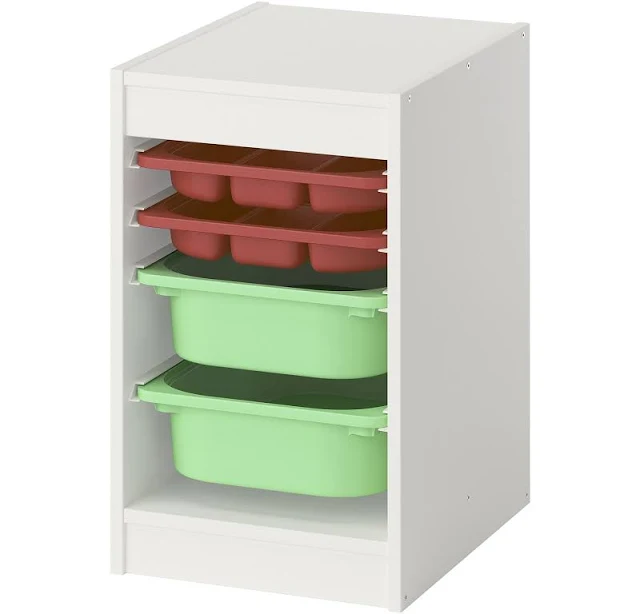
This is the toy storage most Australian parents end up with eventually, and for good reason. The frame comes in a few heights and widths, and you choose your own mix of plastic or fabric boxes to slot in, which means a family with a toddler in a small apartment and a family with three kids in a Queenslander can both build a version that fits their space.
The real strength is flexibility over time. Start with a low, short frame near the floor for a 1 to 3 year old, then add a taller unit as toy collections grow into the primary-school years. Approx RRP for a basic frame with a few boxes sits around $80 to $150, with larger, fully loaded configurations climbing toward $300 to $400 depending on how many boxes you add.
- Modular, so you’re not locked into one size or configuration
- Low, open boxes suit toddlers who need to see and choose for themselves
- Needs wall anchoring once you go beyond the shortest frame, and the hardware for this must be used properly
- Plastic boxes can discolour or crack after a few years of hard use
- Assembly required, and a full wall setup takes a proper afternoon, not twenty minutes
IKEA TROFAST Storage Combination
2. Anko Foldable Storage Cube (3 Pack)
Anko, the house brand behind a huge slice of Australia’s budget kids’ storage, makes a genuinely decent fabric cube that folds flat when not in use and slots into any standard cube shelving unit you already own. It’s the closest thing to the “$15 hack” this guide is named for, and for light to medium toy loads, it does the job without fuss.
It suits families who want to try open storage before spending big, or who need a quick top-up around a birthday or Christmas influx. Approx RRP for a set of three sits around $15 to $25.
- Genuinely cheap, so buying a few extra as the toy pile grows isn’t a big decision
- Folds flat for storage or moving house, useful for renters
- Fabric will sag or fade with heavy daily use over a year or two
- Needs an existing shelf or cube frame to sit inside, it’s not freestanding on its own
- Not suitable for heavy items like wooden blocks or a box of die-cast cars
Anko Foldable Storage Cube (3 Pack)
3. Boori Country Toy Box
Boori is an Australian nursery furniture brand best known for cots and change tables, and their Country toy box is built to match, in solid timber with a finish designed to sit alongside the rest of a nursery or kids’ room rather than looking like an afterthought. This is the premium pick for parents who want one beautiful, sturdy piece rather than a wall of plastic bins.
It’s a genuine furniture investment rather than a quick fix, and it suits a family settled in their home rather than one likely to move rentals soon. Approx RRP sits around $300 to $450 depending on the finish.
- Solid timber construction built to last well beyond the toddler years
- Designed to coordinate with matching Boori nursery furniture
- Heavier and pricier than plastic alternatives, and not something you’ll casually replace
- A hinged lid means checking it has a soft-close or supported mechanism before buying, given the finger-pinch risk with basic toy chests
- Single large space inside, so it suits bulkier toys better than small pieces that need sorting
Boori Country Toy Box
4. 3 Sprouts Storage Bin (Set of 3)
3 Sprouts makes the canvas storage bins with the friendly animal faces that turn up in a lot of Australian nurseries, and they’re a smart middle option between the cheapest fabric cubes and full furniture systems. The picture on the front doubles as a label a pre-reader can recognise, which genuinely helps a 2 to 4 year old put things away themselves.
They’re best used as a category system, one bin for blocks, one for cars, one for soft toys, rather than a single catch-all. Approx RRP for a set of three sits around $60 to $90.
- Picture labelling supports independent tidy-up before a child can read
- Sturdy canvas holds shape better than the cheapest fabric cubes
- Pricier per bin than a basic fabric alternative
- Still needs a shelf, cube unit or floor space to sit in or on
- Not designed for heavy toys, best for soft toys, blocks and small figures
3 Sprouts Storage Bin (Set of 3)
5. Keter Eco Storage Box
Keter’s outdoor-rated storage boxes aren’t marketed as toy storage specifically, but they’re a genuinely popular overflow solution for Australian families with a patio, garage or outdoor play area, holding ride-on toys, sandpit gear and outdoor balls that would otherwise clutter the hallway. Made from weatherproof recycled plastic, it copes with sun and rain far better than an indoor storage piece would.
This is a practical, unglamorous pick for the toys that live outside rather than in the playroom. Approx RRP sits around $50 to $90 depending on size.
- Weatherproof, so it genuinely works outdoors year-round
- Large capacity for bulky outdoor toys, bikes helmets and sandpit tools
- Lid isn’t designed with the same soft-close safety focus as indoor kids’ furniture, so supervise use
- Not designed for small, sortable pieces like blocks or craft supplies
- Bulky footprint, so it needs genuine outdoor space
Keter Eco Storage Box
| Product | Brand | Approx RRP | Key features | Best for |
|---|---|---|---|---|
| IKEA TROFAST Storage Combination #1 | IKEA | approx $80 to $400 | Modular frame and boxes, expandable | Growing toy collections, any room size |
| Anko Foldable Storage Cube (3 Pack) Budget | Anko | approx $15 to $25 | Folds flat, fits standard cube shelves | Trying open storage on a tight budget |
| Boori Country Toy Box Premium | Boori | approx $300 to $450 | Solid timber, matches nursery furniture | Families wanting one furniture-grade piece |
| 3 Sprouts Storage Bin (Set of 3) | 3 Sprouts | approx $60 to $90 | Picture-labelled canvas bins | Pre-readers learning to self-sort toys |
| Keter Eco Storage Box | Keter | approx $50 to $90 | Weatherproof recycled plastic | Outdoor toys, ride-ons and sandpit gear |
Not sure yet? Put all 16 storage & organisation we rate next to each other.
mum. Approved: our top 3 for 2026
Grows with your kid from toddler blocks to primary-school Lego, without needing to be replaced.
The cheapest genuine way to try open, self-serve toy storage before committing to more.
Built like furniture, not a plastic bin, and it’ll outlast the toddler years by a long way.
What to skip, and what to check before you buy
A few of the most common toy storage regrets are avoidable if you check the right thing before it’s assembled in the corner of the lounge room.
- Skip old-style toy chests with unsupported heavy lids, particularly for a mobile toddler under 3 years, unless it has a soft-close hinge you’ve checked in store or in the product listing.
- Skip fully closed drawer systems for the youngest kids, since a toddler who can’t see what’s inside a drawer is far less likely to choose and return toys independently.
- Check the anchoring hardware is included for any tall unit, and actually use it, especially once your child starts climbing furniture rather than just crawling past it.
- Check floor space and door swing before buying a large furniture-grade system, since a beautiful unit that blocks a wardrobe door becomes a source of daily frustration.
- Skip buying one giant unit before you know your child’s play style, if you have a first baby, since interests and toy categories change fast in the first two years.
Frequently asked questions
Do I need to anchor toy storage furniture to the wall in Australia?
If a unit is tall, has drawers a child could climb using as steps, or is top-heavy when loaded, yes, it should be anchored. Most flat-pack systems include anti-tip hardware in the box, and it’s worth using it even for units marketed as low or toddler-height, since kids climb earlier than most parents expect.
What age is toy rotation storage best suited to?
Toy rotation, where only a portion of toys are out at any time, tends to work best from about 12 months through early primary school, since it’s the window where a smaller, curated selection genuinely holds attention longer than a room full of everything at once. Open, low bins make rotation far easier than closed drawers or high shelves.
Are fabric storage bins safe for babies who still put things in their mouths?
Fabric bins themselves are generally fine, since the concern is usually the toys inside rather than the bin. Just check any bin doesn’t have small decorative buttons, loose trims or drawstrings that a baby or crawling toddler could pull off and mouth, and keep bins for babies under 12 months free of anything with detachable small parts.
Is it cheaper long-term to buy one big system or several small hacks over time?
It depends on how settled your household is. A modular system bought once tends to work out cheaper per year of use if you’re staying put, since you’re not replacing sagging fabric bins every year or two. If you’re renting and likely to move, cheaper individual pieces you can pack flat often make more practical sense, even if the per-item cost is a little higher over time.
How much toy storage does a family actually need before a birthday or Christmas?
A good rule of thumb is to have roughly a third more capacity than your child currently owns, so new gifts have a home without an immediate overflow crisis. Pairing this with a clear-out of outgrown toys before the big day tends to matter more than buying extra storage on top of an already full system.
If we had to choose one, the IKEA TROFAST Storage Combination is our 2026 pick, because it’s the rare system that genuinely grows with a child instead of being replaced every developmental leap. On a tighter budget, the Anko Foldable Storage Cube (3 Pack) won’t let you down, and for parents wanting one lasting furniture piece rather than a wall of bins, the Boori Country Toy Box is worth the extra spend.
Where to buy these picks
✓ Verified prices are checked live at the retailer. Otherwise we show the approximate RRP (an indicative recommended price, not a live retailer price), or “price pending” where we don’t have one.
Anko Foldable Storage Cube (3 Pack)
★ Best budget storage cubes
IKEA TROFAST Storage Combination
★ Best for growing with your child
Boori Country Toy Box
★ Best furniture-grade toy box
Little Ones Fabric Storage Bins (3 Pack)
Best for existing shelving
Anko Canvas Toy Box with Lid
Best for one big toy dump
Anko Kids Toy Storage Trolley
Best for toddlers on the move
Show all 11 picksShow fewer
Keter Eco Storage Box
Best for outdoor toys
3 Sprouts Storage Bin (Set of 3)
Best for pre-readers sorting toys
Humble Crew 6-Bin Toy Organizer
Best for shared kids' rooms
Keter Two-in-One Storage Chest and Bench
Best storage with seating
Incy Interiors Marcel Bookcase
Best long-term nursery bookcase
Keep reading
The shortlist, in your inbox
New winners, price drops and recalls worth knowing.