

Baby Toothbrush Guide for Australian Parents: When to Start and Which to Buy
The first tooth usually turns up quietly: a tiny white edge on the bottom gum, spotted mid-nappy change or while a baby gnaws your knuckle. A baby toothbrush is worth buying the day that tooth breaks through, and it does not need to cost much. A small head, extra-soft bristles and a handle you can steer are what matter, and that tells you which infant toothbrush is worth buying.
We have compared a shortlist of infant toothbrushes sold in Australia on their published specs: head size, bristle type, stated age range and handle shape. That should let you choose one and get on with your day.
One note on how we work: we have not tested these products ourselves. This guide is built from manufacturers’ published specs and general dental guidance, and where a detail varies by pack we say so and point you to the label.
When to start brushing baby teeth
The rule: when the first tooth appears
Dental guidance generally suggests starting to clean teeth as soon as they erupt. For most babies that is around six months, though anywhere from four to twelve months is normal. Some babies are born with a tooth, and some are still gummy at their first birthday.
Before the first tooth
You do not need a toothbrush for a toothless baby, but wiping the gums gently with a clean damp cloth after feeds is a harmless habit. It gets them used to having something in their mouth that is not a feed or a toy.
What the early routine looks like
- Twice a day: once in the morning and once before bed. The bedtime brush matters most, because less saliva flows overnight.
- You do the brushing: babies and toddlers cannot clean their own teeth properly. Dental guidance generally suggests an adult brushes, or at least finishes the job, for several years. Ask your dentist when your child is ready to take over.
- Water only at first: wet the brush with water in the early months. See the toothpaste section below.
- A dentist visit around the first birthday: dental guidance generally suggests a first check-up by about 12 months. It is also a good time to ask about fluoride for your area and your child.
If your baby hates it
Very common, and not a sign you are doing it wrong. Let them hold a second brush while you use the other one, brush at the same time as you brush your own teeth, and keep it short. Thirty seconds of consistent brushing beats three minutes of tears.
What to look for in an infant toothbrush
There is no glamour here, so the criteria are simple. The physical design does most of the work.
- Extra-soft bristles: infant gums and new enamel are delicate, and soft bristles are what dental guidance generally recommends at this age.
- A tiny head: it has to reach the back of a very small mouth without gagging them, and clean one or two teeth at a time.
- A chunky, easy-grip handle: you hold it, so it should sit securely in an adult hand even with a squirming baby.
- A guard or wide neck: a flared or shaped handle helps stop the brush going too far back, which matters once babies start to bite and lunge.
- One-piece or securely moulded construction: no small parts that can come loose and become a choking hazard.
- Clear age range on the pack: look for a stated infant range such as 0 to 2 years or 4 to 24 months, not a toddler or kids brush with firmer bristles.
- Easy to rinse and dry: bristles that trap milk and food go grubby fast, so a simple shape cleans better.
What to skip
- Adult or junior brushes used on a baby: the bristles are firmer and the head is too big.
- Brushes with novelty attachments, lights or music that make the handle bulky or add detachable bits.
- Anything with no stated age range or no brand name on the pack.
The baby toothbrushes worth considering
Infant toothbrushes are inexpensive, so the real decision is about your baby’s stage and temperament. A teething baby who chews everything wants something different from a toddler who will let you brush properly. We have not put dollar figures on these picks. Each carries a relative price position (lowest, low, mid or highest of the four), and the live price cards carry the current numbers.
When not to buy
- Before the first tooth: a damp cloth is enough until a tooth appears.
- The BabySonic, if your baby accepts a manual brush: it is not worth buying for a baby who is calm with a basic soft brush.
- A brush with no stated infant age range: skip it, whatever the packaging promises.
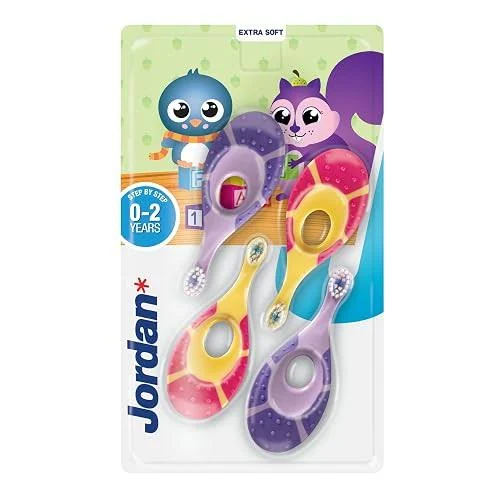
1. Jordan Step 1 (0 to 2 years)
Jordan is a Norwegian oral-care brand, and the Step 1 is its first-stage brush for babies up to two. It combines a very small head and extra-soft bristles with a thick handle designed for an adult to hold and steer. Price position: low.
What puts it ahead of the Oral-B for us is the stated range and the handle. Jordan states 0 to 2 years, the widest manual range here, so one brush covers the first tooth through to the toddler stage. The handle is built around the parent’s grip rather than the baby’s, which is useful when you are the one doing the brushing.
- Stated range: 0 to 2 years, so the same brush works from the first tooth into toddlerhood.
- Head and bristles: small head with extra-soft bristles, as the criteria above ask.
- Handle: thick and shaped for an adult to hold and steer.
- Trade-off: it has no chew or teething features, so a baby who wants something to gnaw may do that instead of letting you brush.
- Check the pack: designs and colours change between releases, so confirm the age range on the box.
Jordan Step 1 (0 to 2 years)
2. Baby Banana Infant Training Toothbrush
The bright banana shape is the whole idea. The curved handle gives small hands something easy to hold, and its shape helps limit how far the brush can be pushed into the mouth. It has short, soft bristles, and the pack states the bristle material and age range, so check both before you buy. Price position: mid.
This suits a baby in the chew-everything phase because the brush looks and feels like a toy they already put in their mouth, which can make it less of a threat. Think of it as a bridge: once your baby is happy to open up, you can move to a standard soft brush with a stated infant age range.
- Shape: the banana handle is easy for small hands to grip and chew, which suits introducing the habit.
- Handle design: the curve helps limit depth, which matters with a lunging baby.
- Trade-off: it is a training brush by name, so treat it as a first step rather than the only brush for years.
- Trade-off: it sits above the basic brushes on price, and milk can linger in the bristle gaps if you do not rinse it well.
Baby Banana Infant Training Toothbrush
3. Oral-B Stages 1 Baby Toothbrush
The Stages range is graded by age, and Stages 1 is the baby step, with a stated range of 4 to 24 months. It has extra-soft bristles, a small head and a soft grip handle, with character designs that change from release to release. Price position: lowest of the four.
The specs are close to the Jordan’s, so the difference is mostly the range and the handle. The stated range starts at 4 months rather than birth, and the handle leans towards child appeal, with its character designs. That makes it a good everyday budget brush and a handy spare for the nappy bag or grandparents’ house.
- Stated range: 4 to 24 months, which covers the first-tooth window for most babies.
- Head and bristles: small head with extra-soft bristles.
- Handle: a soft grip with character designs that can help once your toddler wants a say.
- Trade-off: it has no teething or chew features, so it works best once baby is happy to open up.
- Trade-off: character and colour vary by release, so you cannot always choose the design.
Oral-B Stages 1 Baby Toothbrush
4. Brush-Baby BabySonic Electric Toothbrush
Brush-Baby makes this battery-powered brush for babies and toddlers. It uses gentle sonic vibration with very soft bristles and a small head, and the pack states the age range. Price position: highest of the four.
The appeal is that some babies who refuse a manual brush are fascinated by a soft buzz. Dental guidance does not say an electric brush is required at this age, and it is not worth buying for a baby who accepts a manual one. It is worth considering only after a manual brush has repeatedly ended in tears.
- Why consider it: the vibration can distract babies who resist a manual brush.
- Head and bristles: small head with very soft bristles.
- Trade-off: the highest price tier here by a good margin, plus battery upkeep.
- Trade-off: some babies are unsettled by the vibration, so keep a manual brush as a fallback.
- Check the pack: confirm the stated age range covers your child before you buy.
Brush-Baby BabySonic Electric Toothbrush
Side by side
| Product | Brand | Price position | Key features | Best for |
|---|---|---|---|---|
| Jordan Step 1 (0 to 2 years) #1 | Jordan | Low | Extra-soft bristles, small head, thick adult-grip handle, 0 to 2 years | One brush from first tooth to toddler |
| Baby Banana Infant Training Toothbrush | Baby Banana | Mid | Banana-shaped handle, short soft bristles, easy for small hands to hold | Teething babies who chew everything |
| Oral-B Stages 1 Baby Toothbrush Budget | Oral-B | Lowest | Extra-soft bristles, small head, soft grip handle, 4 to 24 months | Low-cost everyday brush or spare |
| Brush-Baby BabySonic Electric Toothbrush Premium | Brush-Baby | Highest | Gentle sonic vibration, very soft bristles, small head | Babies who reject manual brushing |
Not sure yet? Put all 4 grooming we rate next to each other.
Baby toothpaste, fluoride and technique
Under 18 months
Dental guidance generally suggests brushing with a soft brush and water only at this age. The main goal is building the habit. If your dentist or child health nurse thinks your baby is at higher risk of decay, they may recommend something different, so ask at that first visit.
From about 18 months
Guidance generally moves to a low-fluoride children’s toothpaste in a pea-sized amount. Check the label for the age range and fluoride content, and ask your dentist what suits your child. Brush, then have your child spit if they can. Many dentists suggest not rinsing with water afterwards, so the fluoride stays on the teeth a little longer.
What the label on baby toothpaste really means
- Fluoride-free baby toothpaste: marketed as safer to swallow, which is true, but it also lacks the decay protection fluoride gives. Whether it suits your child is a question for your dentist.
- Low-fluoride children’s toothpaste: made for toddlers and young children, and the usual choice once your child is old enough.
- Adult toothpaste: formulated for adults, so leave it on the bathroom shelf for now.
What comes after Step 1 and Stages 1
Both the Jordan Step 1 and the Oral-B Stages 1 stop at about two years. At around 18 to 24 months, when you switch to a children’s toothpaste, move to a toddler brush with a stated range for the next age band. Choose one with a slightly larger head, still with soft bristles.
Technique that works
- Sit baby on your lap facing away from you, or lie them on a change mat with their head in your lap.
- Use small circles along the gumline, front and back, one or two teeth at a time.
- Replace the brush about every three months, or sooner if the bristles splay or after a cold or illness.
- Rinse the brush and let it air dry upright, away from other brushes.
Questions parents ask about baby toothbrushes
Can I use a silicone finger brush instead?
A finger brush can be a gentle way to introduce the habit, especially for a baby who is teething and likes to chew. As more teeth come through, ask your dentist or child health nurse whether it is still enough or whether to switch to a small soft-bristled brush.
What if my baby swallows some toothpaste?
A tiny accidental swallow from a small smear is not usually a concern, which is why the amount is kept small. If your child has swallowed a larger amount, call the Poisons Information Centre on 13 11 26 or seek medical advice. Keep the tube out of reach.
When do I move from a Step 1 brush to a toddler brush?
Both the Jordan Step 1 and Oral-B Stages 1 top out at about two years. Move on at around 18 to 24 months, when the toothpaste changes too, and pick a brush whose pack states the next age band.
My baby just chews the brush. Does that still count?
Chewing is normal and a good first step. Give them one brush to gnaw while you brush with a second, then take turns. A teething-style brush like the Baby Banana suits this stage.
Is an electric infant toothbrush better than a manual one?
Not necessarily. Consistency matters more than the type of brush, and an electric one is only worth it if your baby refuses a manual one. See the BabySonic pick above.
For most families, buy the Jordan Step 1 (0 to 2 years) and start the day the first tooth appears. It has a small head, extra-soft bristles, a thick adult-grip handle and the widest stated range of the manual brushes here. The Oral-B Stages 1 Baby Toothbrush is the budget alternative: similar head and bristles, with a stated range of 4 to 24 months and a character handle, which makes it a good spare. Choose the Baby Banana Infant Training Toothbrush for a teething baby who needs something to chew, as a bridge to a standard soft brush. Only reach for the Brush-Baby BabySonic if a manual brush keeps ending in tears, because it is not worth buying for a baby who accepts one.
Where to buy these picks
✓ Verified prices are checked live at the retailer. Otherwise we show the approximate RRP (an indicative recommended price, not a live retailer price), or “price pending” where we don’t have one.
Jordan Step 1 (0 to 2 years)
★ Best for first tooth onwards
Baby Banana Infant Training Toothbrush
Best for teething babies
Oral-B Stages 1 Baby Toothbrush
Best budget pick
Brush-Baby BabySonic Electric Toothbrush
Best for brush refusers
The shortlist, in your inbox
New winners, price drops and recalls worth knowing.