
Best Kids Bookshelf Australia 2026: Forward-Facing vs Traditional (Storage That Actually Works)
If you’ve ever watched your little one ignore a perfectly organised bookshelf only to drag out the same three picture books from a messy pile on the floor, you’re not alone. Choosing the right kids bookshelf is one of those parenting decisions that seems simple until you’re standing in Baby Bunting comparing six different styles and wondering why one costs $89 and another costs $399.
Here’s the thing Australian parents consistently report: the bookshelf you choose actually changes how often your child reads. A toddler can’t browse a shelf where only book spines are visible, they need to see those bright covers. But an eight-year-old with a growing chapter book collection needs proper shelf storage, not a Montessori-style display rack.
This 2026 guide cuts through the marketing fluff. We’ve compared forward-facing displays, traditional shelves, and hybrid designs available right now across Baby Bunting, Kmart, Target AU, Big W and IKEA Australia, with honest pros, cons, and current AUD pricing so you can buy once and buy well.
Forward-Facing vs Traditional Bookshelves: What’s the Real Difference?
Forward-facing bookshelves (sometimes called Montessori-style or front-facing) display books with their covers visible, usually on shallow ledges or sling-style fabric pockets. Traditional bookshelves store books vertically with only their spines on show, just like an adult library.
The research backs up what early childhood educators have been saying for years: children under six engage with books significantly more when they can see the cover. Picture books are designed visually, the cover is the invitation. Hide it, and toddlers simply walk past.
But forward-facing shelves have a catch. They typically hold only 15–25 books at a time, compared to 80–150 books on a traditional shelf of the same footprint. For families with growing libraries (especially once chapter books arrive around age 6–7), pure forward-facing storage becomes impractical fast.
Quick comparison at a glance
| Feature | Forward-Facing | Traditional | Hybrid |
|---|---|---|---|
| Best age range | 0–5 years | 6+ years | 2–10 years |
| Book capacity | 15–30 books | 80–150 books | 40–70 books |
| Encourages independent reading | Excellent | Moderate | Very good |
| Longevity | 2–4 years | 10+ years | 5–8 years |
We’ve reviewed 16 storage & organisation in total — compare the full list before you decide.
What to Look For in a Quality Kids Bookshelf in 2026
Before we dive into specific products, here’s the checklist we use when reviewing any kids bookshelf. These are the non-negotiables.
- ACCC compliance and tip-over safety: Following updates to Australia’s furniture safety guidance in recent years, any bookshelf taller than 60cm should come with anti-tip wall anchors. Check that the product description explicitly mentions this, surprisingly, many cheaper imports still don’t include them.
- Rounded corners and edges: Especially important for under-fives. Run your hand along every edge before purchasing if buying in-store.
- Non-toxic finishes: Look for E1 or E0 rated MDF, water-based paints, and certifications like GREENGUARD Gold if you’re sensitive to off-gassing.
- Weight capacity per shelf: A loaded shelf of hardcover picture books is heavier than you’d think. Look for a minimum 5kg per shelf rating.
- Height appropriate for the child: The whole point is independent access. If your three-year-old can’t reach the top shelf, those books may as well not exist.
- Easy to clean: Wooden or laminate surfaces beat fabric slings every time when Vegemite fingers are involved.
Best Forward-Facing Kids Bookshelves Australia 2026
These are ideal for nurseries, toddler rooms, and reading corners for kids under six. They prioritise display and accessibility over storage volume.
1. IKEA Flisat Book Display
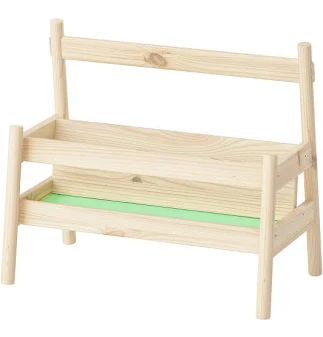
The benchmark forward-facing shelf in Australia, and for good reason. Solid pine, four tiered ledges, holds around 20–25 picture books with covers visible. Unfinished wood means you can leave it natural or paint to match the room.
Pros: Excellent quality, low profile (safe for toddlers), beautiful natural finish, IKEA quality control.
Cons: Limited capacity, requires assembly, may need sealing if you want a wipeable finish.
IKEA Flisat Book Display
2. Mocka Bookshelf (Forward-Facing)
An Aussie favourite available directly through Mocka. Five shelves, room for around 30 books, available in white, natural, and grey. Sturdy MDF construction with rounded corners.
Pros: Higher capacity than IKEA, multiple colour options, free delivery over $99, designed in New Zealand for ANZ homes.
Cons: MDF rather than solid wood, occasional stock shortages on popular colours.
3. Kmart Kids Front-Facing Bookshelf
Kmart’s budget-friendly entry holds around 15–20 books across three ledges. White finish, simple flat-pack assembly.
Pros: Genuinely affordable, widely available, decent finish for the price.
Cons: Lightweight construction (definitely anchor this one), smaller capacity, finish chips if knocked.
4. Target AU Pine Book Display
Solid pine forward-facing display with a more rustic look. Four ledges, holds about 25 books.
Pros: Solid wood feel at a mid-range price, attractive aesthetic.
Cons: Heavier so harder to move, natural finish shows marks easily.
Best Traditional Kids Bookshelves Australia 2026
For families with extensive libraries, older children, or shared sibling spaces where capacity matters more than display.
1. IKEA Kallax 2×2 or 2×4
Not technically a kids’ bookshelf, but quietly the most popular choice among Australian parents. Open cube design, endlessly versatile, room for hundreds of books plus toy baskets. Pair with fabric storage cubes from Big W ($12–$18 each) for a polished look.
Pros: Massive capacity, grows with the child into teen years, can be wall-mounted horizontally as a low unit for toddlers, replacement parts easy to find.
Cons: Must be wall-anchored (non-negotiable), basic styling won’t suit every room.
2. Mocka Hudson Bookshelf
Five-tier traditional shelf with a clean Scandi look. Holds 100+ books comfortably. Available in white, oak, and black.
Pros: Looks designer, excellent capacity, anti-tip kit included.
Cons: Higher price point, longer assembly time (allow 90 minutes).
3. Big W Olsen 3-Tier Bookshelf
Budget hero. Three open shelves, white or oak finish, holds around 60 books. Great for a kids’ bedroom on a tight budget.
Pros: Excellent value, simple assembly, low profile suits younger kids.
Cons: Particle board construction, less durable long-term.
4. Baby Bunting Boori Tidy Bookcase
Premium solid timber option from a trusted Australian brand. Built to last through multiple children and look beautiful doing it.
Pros: Heirloom quality, GREENGUARD Gold certified, generous capacity, 10-year warranty.
Cons: Significant investment, heavier to move during room reshuffles.
Best Hybrid Bookshelves: The Sweet Spot for Most Families
Hybrid designs combine forward-facing display at the top or front with traditional storage below or behind. These are honestly what we recommend to most Australian families because they grow with your child and handle the awkward middle years (4–8) beautifully.

Baby Bunting Boori Tidy Bookcase
1. Mocka Aspiring Bookshelf
Two forward-facing display tiers on top, two traditional shelves below. Holds around 50–60 books total. Compact footprint perfect for shared bedrooms.
Pros: Best of both worlds, attractive design, suitable from toddler through primary years.
Cons: Mid-range capacity only, MDF construction.
2. Tidy Books Bookcase
The British design classic now widely available in Australia. Forward-facing front pocket with traditional shelf storage behind. Genius design used in countless preschools.
Pros: Genuinely brilliant design, hand-finished, decade-plus longevity.
Cons: Premium pricing, occasional shipping delays from UK stock.
Tidy Books Bookcase
3. Kmart 4-Tier Bookshelf with Display Top
Recent Kmart release that adds a forward-facing top shelf to a standard four-tier design. Excellent value for what it offers.
Pros: Affordable hybrid option, easy assembly, neutral white finish.
Cons: Forward-facing section is small, lightweight overall.
Setting Up Your Kids Bookshelf for Success
Buying the right shelf is only half the job. How you set it up determines whether your child actually uses it. Here’s what works in real Australian homes.
- Rotate the books. Don’t try to display the entire collection. Choose 15–20 books at a time and swap them weekly. Children re-discover books they’ve ignored for months simply because they’re suddenly front and centre.
- Put it where they actually play. A bookshelf in a formal study no one uses is decoration. Pop a small forward-facing shelf in the lounge near where your toddler plays, and reading sessions multiply.
- Pair with a soft spot. A floor cushion, beanbag, or sheepskin rug nearby signals “this is a reading place.”
- Anchor it. Always. The ACCC recommends anchoring all furniture over 60cm tall in homes with young children. It takes ten minutes. Do it.
- Keep it at their height. If your child can’t reach the top shelf without help, store seasonal or adult-managed books up there (like Christmas titles in November) and keep current favourites at eye level.
Common Mistakes Australian Parents Make
The same bookshelf regrets come up again and again.
Buying too small, too soon. That gorgeous little forward-facing rack you bought for the nursery? It’s full within a year of birthdays and Bookclub orders. Either accept that you’ll upgrade around age four, or buy a hybrid from the start.
Choosing fabric slings. They look adorable in catalogue photos. In real life, they sag within months, books slip out constantly, and they’re impossible to clean. We don’t recommend them.
Skipping the anchor kit. Even sturdy-looking shelves tip when a determined toddler decides to climb. This isn’t theoretical, it’s the leading cause of furniture-related child injuries in Australia.
Buying based on aesthetics alone. That stunning timber ladder shelf from a designer brand? Beautiful, but a death trap for under-fives and impossible to load with picture books that won’t slide off angled shelves.
Putting it in the wrong room. Bedrooms are fine for older children, but for toddlers, the bookshelf belongs in the main living area where you spend the most time together.
mum.com.au Approved: Our 2026 Top Picks
After comparing bookshelves available in Australia this year, these are our genuine recommendations across budgets and ages.
Best Overall: Mocka Aspiring Bookshelf
The hybrid design wins because it actually grows with your child. Forward-facing display for the toddler years, traditional shelves below for the chapter book phase. Australian-friendly delivery, attractive in any room, and the price sits in the sweet spot between budget and premium.
Best Budget: Kmart 4-Tier Bookshelf with Display Top
If money is tight, this delivers genuine value. Anchor it properly, accept it won’t last forever, and enjoy a hybrid shelf for the price of a single weekly shop.
Best for Toddlers: IKEA Flisat
Pure forward-facing perfection for the under-fives. Solid wood, gorgeous, and your toddler will actually use it. Plan to add a traditional shelf around age five.
Best for Big Libraries: IKEA Kallax 2×4
If your family is serious about books, nothing beats Kallax for sheer capacity and longevity. It’ll still be useful when your child heads off to uni.
Best Premium Pick: Baby Bunting Boori Tidy Bookcase
Worth it if you want furniture that lasts through multiple children and beyond. The kind of piece you’ll still be using in fifteen years.
Our top pick across the board for most Australian families.
The value choice when you want the essentials without overspending.
The splurge pick if you want the most features and finish.
Frequently Asked Questions
At what age should I get my child their own bookshelf?
Most Australian families set up a forward-facing shelf around 12–18 months, when babies start showing interest in choosing their own books. Before this, a small basket of board books works perfectly well. Don’t rush, there’s no developmental need for a bookshelf before your child can sit independently and grab books themselves.
Are forward-facing bookshelves worth the extra money?
For children under six, yes, absolutely. The research on cover visibility and reading engagement is consistent. After age six or seven, when children start choosing books based on author or series rather than cover art, traditional storage becomes more practical. This is exactly why hybrid designs have become so popular.
How do I anchor a bookshelf to a plasterboard wall?
Most quality bookshelves come with anti-tip kits including a strap and the screws needed. For plasterboard (the standard in most Australian homes), use the included wall anchors, typically a toggle bolt or hollow wall anchor, rather than screwing directly into plasterboard. If you can locate a stud behind the wall, even better. Bunnings staff can help if you’re unsure which anchor suits your wall type.
What’s the safest height for a kids bookshelf?
For children under three, keep shelves under 90cm tall where possible, this reduces climbing risk and lets your child actually access every book. For ages 3–7, up to 120cm works well. Taller shelves are fine for primary school children, but always anchor securely regardless of height.
Should I buy a kids bookshelf or just use a regular shelf?
A regular adult bookshelf works fine for school-aged children as long as it’s properly anchored and you keep the top shelves for less-used items. For toddlers and preschoolers, though, a dedicated kids bookshelf, particularly forward-facing, genuinely changes reading habits. The IKEA Kallax laid horizontally is a brilliant compromise that works for all ages.
The Bottom Line
The best kids bookshelf is the one your child actually walks up to and uses. For most Australian families, that means starting with forward-facing display in the toddler years and transitioning to a hybrid or traditional shelf as the library grows. If we had to pick just one recommendation for 2026, the Mocka Aspiring Bookshelf at $199 is the most versatile option for most homes, it works from age two right through to ten.
Whatever you choose, three things matter more than the brand: anchor it securely, put it where your child actually plays, and rotate the books regularly so the collection always feels fresh. Do those three things with a $89 Kmart shelf and you’ll get better results than a $400 designer piece sitting unused in a formal lounge.
Happy reading, mums. Your future selves, and your little bookworms, will thank you.
Where to buy these picks
✓ Verified prices are checked live at the retailer. Otherwise we show the approximate RRP (an indicative recommended price, not a live retailer price), or “price pending” where we don’t have one.
All 4 prices we track for this pick
- Baby Kingdom $477.15 checked 7 Oct 2026
- Baby Little Planet $483.16 checked 7 Oct 2026
- Kiddie Country $483.16 checked 7 Oct 2026
- Boori $499.95 checked 7 Oct 2026
IKEA Flisat Book Display
Best for toddler picture books
Tidy Books Bookcase
Best thoughtful design
Keep reading
The shortlist, in your inbox
New winners, price drops and recalls worth knowing.