
Best Toddler Trampolines Australia 2026: Are Mini Trampolines Actually Safe?
It’s usually a wet Tuesday afternoon or a toddler who has just discovered how to launch themselves off the couch that sends a parent searching “toddler trampoline” at 9pm. You don’t want forty tabs open comparing spring covers and net heights, you want to know: is this actually safe for a two or three year old, and which one won’t end up as a $150 lesson in why you should have read the fine print first.
We’ve spent the research hours you don’t have, cross-checking real products sold in Australia against the trampoline safety standard, genuine size and weight specs, and what paediatric and playground safety bodies actually recommend for the under-fives. This guide covers dedicated toddler trampolines, plus honest thoughts on when a toddler swing or toddler climbing frame might suit your backyard and your child’s stage better.
Nothing here is sponsored puffery. Where we’re confident a product earns its spot, we say so plainly, and where a trade-off matters (no net, a low weight limit, a size your toddler will outgrow in a year), we say that too.
Are toddler trampolines actually safe?
The short answer
Conditionally, yes, but the condition is the whole point. A toddler trampoline used by one small child at a time, on level grass, with constant adult supervision and a properly zipped net enclosure, is a genuinely low-risk way to burn off energy. The injuries that make headlines almost always involve multiple children jumping together, trampolines placed on concrete or near fences, or nets that were never zipped up in the first place.
What the Australian Standard actually covers
Home trampolines sold in Australia are expected to meet AS 4989, the standard covering trampoline safety aspects such as padded spring and frame covers, enclosure net height and mesh size, and a declared maximum user weight. It’s worth noting that some smaller trampolines aimed at indoor toddler play are marketed and tested as toys instead, which brings them under AS/NZS ISO 8124 (toy safety) rather than AS 4989. Neither standard is a substitute for supervision, but they tell you the manufacturer has had the padding, netting and structural points independently assessed.
Non-negotiables before you buy
- One jumper at a time: most toddler trampoline injuries involve a second, usually older, child jumping alongside a toddler.
- Grass or soft fall surface: never set up on concrete, pavers or decking, even temporarily.
- Clear zone around it: at least a metre from fences, garden edging, trees and the clothesline.
- Net zipped every single time: an unzipped net is worse than no net, because it creates a false sense of security.
- Manufacturer’s minimum age respected: most toddler models are rated from around age 3, once a child can jump and land with reasonable control.
What to look for in a toddler trampoline
Before you compare specific models, run through this checklist. It’s what separates a trampoline you’ll trust for the next two or three years from one you’ll be replacing after a single Christmas.
- A full safety net enclosure: for outdoor use, this is the single biggest safety upgrade over a bare mat, and it’s the first thing to check on the box.
- Padded spring and frame covers: exposed springs are a pinched-finger and rolled-ankle risk for small hands and feet.
- A clearly stated weight limit and age range: toddler models are usually built for a single child under around 45kg, not a sibling pile-on.
- Mat size that suits your toddler, not your Instagram feed: a smaller 4ft mat is easier to supervise and less tempting for older kids to join in on.
- Indoor vs outdoor construction: indoor mini trampolines are lighter and often lack a net, which changes how closely you need to supervise.
- Storage and portability: renters and small-yard families should check whether it folds flat or needs to be dismantled.
The best toddler trampolines in Australia for 2026
These three cover the realistic range a parent actually needs to choose between: an indoor budget option without a net, a solid netted outdoor all-rounder, and a springless premium pick for families willing to spend more on peace of mind.
1. Lifespan Kids Kada 4ft Trampoline
Lifespan Kids is an Australian trampoline specialist, and the Kada is sized specifically for toddlers and preschoolers rather than being a shrunk-down version of a backyard trampoline built for a ten year old. It comes with a full safety net enclosure and padded spring covers, and the company backs its frames with an Australian warranty and support line, which matters if a part needs replacing in year two.
The trade-off is size: at 4ft, this is genuinely a toddler-only trampoline, and most children outgrow it in terms of interest (though not always weight limit) by around age five or six. It’s not a trampoline that grows with your family long-term, but that’s arguably the point for a toddler-specific buy.
- Full net enclosure with padded spring covers
- Compact 4ft footprint suits smaller courtyards and townhouse backyards
- Australian-based warranty support
- Best suited to a single child; not built for sibling jumping sessions
- Will be outgrown in interest well before the frame wears out
Lifespan Kids Kada 4ft Trampoline
2. Little Tikes Easy Store Trampoline
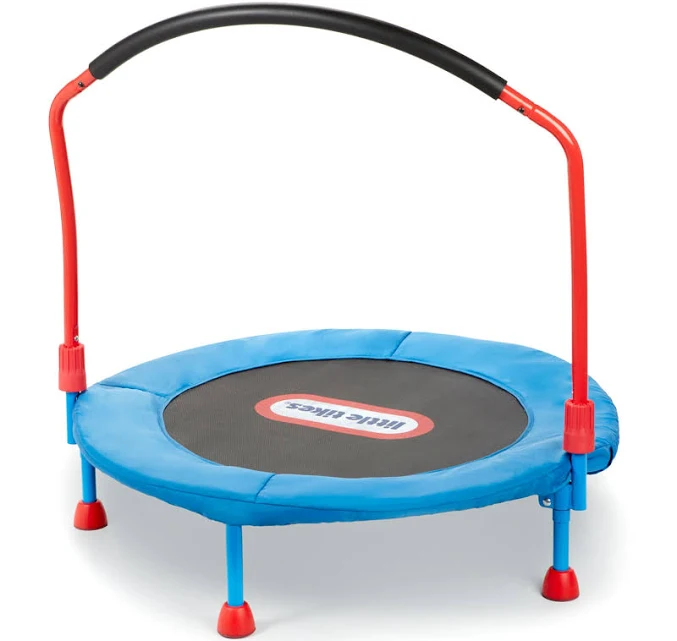
This is the trampoline most Australian parents have actually seen in real life, usually folded flat against a garage wall or wheeled out onto a balcony. It’s a genuine toy-category product designed for indoor or covered outdoor use, with a padded handle bar toddlers can hold for balance, which matters a lot for a two or three year old still working on their landings.
It has no safety net, which is the honest trade-off for the lower price and smaller indoor footprint. That makes constant, close supervision non-negotiable rather than a nice-to-have, and it’s not the pick for a backyard where you want to duck inside to answer the door.
- Approx. RRP $100 to $150, one of the more affordable entry points into this category
- Padded handle bar helps toddlers balance while learning to bounce
- Folds flat for storage in an apartment or small laundry
- No net enclosure, so hands-on supervision is essential every time
- Best suited to indoor or undercover use rather than full-sun backyard placement
Little Tikes Easy Store Trampoline
3. Plum 4.5ft Wavy Junior Trampoline & Enclosure
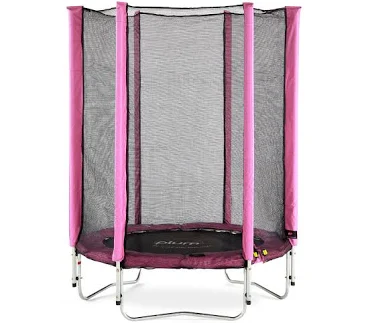
Plum’s Wavy range uses a springless design, with the bounce coming from flexible rods rather than exposed metal springs, which removes one of the more common toddler injury points (fingers and toes caught between mat and spring). Paired with a full net enclosure and a slightly larger 4.5ft mat, it’s built to see a family through the toddler years and into early primary school.
It sits at the premium end of the toddler trampoline category, and the springless design means a slightly firmer bounce than a traditional spring trampoline, which some toddlers need a session or two to adjust to. For families who want the safest structural design available at this size, though, it’s the standout.
- Approx. RRP $230 to $280, reflecting the springless build and larger mat
- No exposed springs, reducing pinch and trap injury risk
- Full net enclosure with padded frame
- Firmer bounce feel than spring-based models, which takes some getting used to
- Larger footprint than a 4ft model, so measure your space first
Plum 4.5ft Wavy Junior Trampoline & Enclosure
How the toddler trampolines compare
| Product | Brand | Approx RRP | Key features | Best for |
|---|---|---|---|---|
| Kada 4ft Trampoline #1 | Lifespan Kids | $170 to $220 | Full net enclosure, padded springs, compact 4ft mat | Backyard families wanting a proper toddler-sized all-rounder |
| Easy Store Trampoline Budget | Little Tikes | $100 to $150 | Padded handle bar, folds flat, no net | Indoor use and small spaces under close supervision |
| 4.5ft Wavy Junior Trampoline & Enclosure Premium | Plum | $230 to $280 | Springless design, full net enclosure, larger mat | Families prioritising structural safety and a longer usable life |
We’ve reviewed 49 outdoor & active in total — compare the full list before you decide.
What about a toddler swing or climbing frame instead?
A trampoline isn’t the only answer to a toddler with too much energy and not enough backyard to put it in. For some families, a toddler swing or a toddler climbing frame is actually the better first purchase, particularly for children under three who aren’t yet confident jumping and landing.
When a swing makes more sense
A toddler swing with a bucket-style seat and full harness suits children from around 9 months once they can sit unassisted, well before most trampolines are recommended. Sets like the Plum Grand Portico Wooden Swing Set combine a toddler bucket swing, a standard swing, and a small climbing wall in one frame, which is a genuinely popular option for families wanting play equipment that grows with a child from baby swing through to early primary climbing. It’s a bigger investment, often upwards of approx. $500, but it covers several developmental stages rather than being outgrown in a year.
When a climbing frame earns its space
For toddlers who love scrambling more than bouncing, a compact indoor option like the Little Tikes Climb and Slide Curvy Slide gives a safe, low-height climbing and sliding structure suited to children from around 18 months, ideal for units and townhouses without backyard space. For a bigger outdoor investment, sets like the Lifespan Kids Traverse Metal Swing Set pair a swing bay with an integrated climbing frame and monkey bars, though the monkey bar section is generally a wait-until-they’re-older feature rather than a toddler one.
- Choose a trampoline if your toddler is 3 or older, confident on their feet, and you have flat grass to place it on.
- Choose a toddler swing if your child is younger than 3, or you want equipment that starts useful now and keeps going for years.
- Choose a climbing frame if your toddler is a climber more than a jumper, or you’re working with limited indoor space.
- Consider a combo set if you have the yard space and budget to cover swing, slide and climbing in one purchase rather than staggering buys.
mum. Approved: our top 3 for 2026
The right size and safety features for a toddler, backed by local warranty support.
An affordable, foldable indoor option for a supervised bounce session.
Springless design removes a real injury point, worth the extra spend.
Frequently asked questions
What age can a toddler start using a trampoline?
Most manufacturers rate toddler trampolines from around age 3, once a child can jump and land with some control. Younger toddlers are better suited to supervised, gentle bouncing on a soft mat rather than an unassisted trampoline session.
Do toddler trampolines need a safety net enclosure?
For outdoor trampolines, yes, a full net enclosure is one of the biggest safety upgrades available and should be treated as essential rather than optional. Indoor mini trampolines are sometimes sold without a net, but that means adult supervision has to be constant and close.
Can a toddler trampoline be used indoors?
Some models, like the Little Tikes Easy Store Trampoline, are designed specifically for indoor or covered outdoor use and are lighter and more compact than a backyard trampoline. Check the product’s stated use before placing any trampoline on a hard indoor floor without a soft mat underneath.
What Australian Standard applies to trampolines?
Home trampolines are generally expected to meet AS 4989, which covers safety aspects like padded spring and frame covers, net height, and declared weight limits. Smaller trampolines marketed as toys may instead sit under AS/NZS ISO 8124, the toy safety standard.
Should more than one toddler jump at a time?
No. The vast majority of trampoline injuries in young children happen when more than one child is jumping at once, particularly when an older, heavier child jumps alongside a toddler. Toddler trampolines are built and rated for one user at a time.
If we had to choose one, the Lifespan Kids Kada 4ft Trampoline is our 2026 pick for most Australian backyards, thanks to its full net enclosure, toddler-appropriate size and local warranty backing. On a tighter budget, the Little Tikes Easy Store Trampoline won’t let you down, provided you commit to close supervision every single time, and if you want the safest structural design available, the Plum 4.5ft Wavy Junior Trampoline & Enclosure is worth the extra spend.
Where to buy these picks
✓ Verified prices are checked live at the retailer. Otherwise we show the approximate RRP (an indicative recommended price, not a live retailer price), or “price pending” where we don’t have one.
Lifespan Kids Kada 4ft Trampoline
★ Best toddler trampoline
Little Tikes Easy Store Trampoline
Best for small spaces
Plum 4.5ft Wavy Junior Trampoline & Enclosure
Best for lasting durability
The shortlist, in your inbox
New winners, price drops and recalls worth knowing.