

Baby Bottle Steriliser: Microwave, Electric or Dryer? A Plain Comparison
A drying rack holding six bottles, eight teats, a handful of collars and a set of pump flanges is not a tidy kitchen. By the third week of it, most parents are asking whether all this sterilising is even necessary. For young babies, and especially for formula and expressed milk, Australian health guidance does recommend sterilising feeding equipment. How long you keep doing it depends on your baby’s age and circumstances, so check the current Raising Children Network or healthdirect page and confirm with your child health nurse, particularly if bub was premature.
There are really three kinds of baby bottle steriliser (microwave, electric steam, and steam-plus-dry), plus one adjacent appliance that often gets confused with them: the Baby Brezza bottle washer. This guide sorts out which one fits your kitchen, your feeding setup and your return-to-work routine. We have not handled these units ourselves. Every recommendation is built from manufacturer specifications and Australian health guidance.
How the main types of steriliser differ
Before comparing models, it helps to know what each method trades away. One rule applies to all of them: a steriliser does not clean. Bottles need a wash in hot soapy water first, because milk residue left on a surface can shelter bacteria from the steam.
Microwave steam sterilisers
- A plastic tub with a little water in the base. The microwave creates the steam, and the cycle length depends on your microwave’s wattage.
- Lowest cost to buy and smallest to store, so they suit a tight rental kitchen.
- Capacity is modest compared with an electric unit, and the microwave is tied up while it runs.
Electric steam sterilisers
- A standalone unit with its own heating element. You add the amount of water the manual specifies, press a button and walk away.
- Suits a stable routine with several bottles a day.
- Takes bench space, and the heating element will scale up over time, especially in hard water.
Steam-and-dry machines
- These steam the load, then blow warm filtered air through it so parts come out dry.
- Drying is the real upgrade. Wet parts shut in a closed lid are what lead to a stale smell, and a dryer removes that step.
- They cost more than a microwave model and have the biggest footprint of the steriliser options.
The cheap alternatives
- Boiling on the stove: fully submerge heat-safe parts for the time the manufacturer specifies. It costs nothing but it is fiddly and hot.
- Cold-water tablets or solution such as Milton: no heat, handy for travel, but you soak in a container and rinse, so it is slower for daily use.
- Microwave steam bags such as Medela Quick Clean Micro-Steam Bags: designed for pump parts and a bottle or two, which makes them handy at work or on the road.
When can you stop?
We are not going to put a date on it, because the right answer depends on your baby’s age, whether they were premature, and their health. Guidance can also be updated. Check the current Raising Children Network or healthdirect page, and confirm with your child health nurse before you stop.
What to look for before you buy
- Capacity for your actual load: count bottles, teats, collars and, if you express, pump parts. A reflux or anti-colic bottle with vent inserts has far more parts than a plain bottle. Compare your count with the listed bottle capacity on the product page.
- Bottle compatibility: wide-neck and tall bottles do not fit every tray. Check the maximum bottle height and neck width against what you already own, especially if you combi-feed with more than one brand.
- A drying step: if the unit does not dry, plan for a clean rack or the lid-open guidance in the manual. Wet parts in a closed lid can leave a damp smell.
- Cycle time and hands-off operation: a short automatic cycle matters at 5am. The manufacturer lists the cycle length in minutes in the manual and on the product page. Microwave units need you there to handle hot, steaming parts.
- Age guidance: the manufacturer also states which ages and uses each unit is designed for. Read that before you buy, not after.
- Descaling: electric units build limescale. In hard-water areas such as Adelaide and parts of Perth, expect it to come around often, so look for a clear descaling process in the manual.
- Compliance marking: a mains-powered unit should carry the RCM (Regulatory Compliance Mark), which shows the supplier has declared compliance with Australian electrical safety and electromagnetic requirements. Look for the RCM mark and check the product page for the supplier’s compliance statement, including the Australian plug and voltage.
- Bench footprint: measure the space, including lid clearance and the cord reach.
What to skip
- Anything claiming it cleans as well as sterilises without a wash step, unless it is a dedicated washer.
- Units sold as one-size-fits-all without listing compatible bottle sizes.
- Paying for extra features you will use for only a few months, such as app connectivity.
Who can skip a steriliser, and what running one costs
When a machine may not be worth it
A dedicated machine is not for everyone. Combi-feeding with a bottle or two a day does not automatically mean you need the biggest unit on the shelf.
- Mostly breastfed with the occasional bottle: a microwave tub or steam bags will usually cover it.
- Happy with boiling or Milton and the time they take: a machine only saves minutes.
- Only expressing at work: steam bags are made for pump parts.
- Your child health nurse has said you can ease off: you may not need one at all.
Newborns versus older babies
- Newborns, premature babies and unwell babies: this is where health guidance is most cautious, so follow your hospital or nurse’s advice closely.
- Older babies: guidance on how long to keep sterilising changes with age, so check the current Raising Children Network or healthdirect page rather than relying on an old rule of thumb.
The running costs nobody mentions
- Electric steam units: descaler and regular descaling time, more often in hard-water areas.
- Steam-and-dry machines: the manufacturer’s instructions call for descaling and for replacing the filter on its schedule, so factor in the replacement filters.
- Bottle washers: detergent, plus descaling and cleaning of the machine itself.
- Microwave units: few ongoing costs beyond replacing a worn tub or tray.
Our four picks
1. Philips Avent Electric Steam Steriliser
This is the safest all-rounder for most households. It is an electric steam unit, so it does not need a microwave and the cycle runs on its own while you get on with the morning. Check the listed bottle capacity on the product page against your daily load before buying. Relative cost tier: mid.
The trade-off is drying. As we understand the standard unit, it has no dedicated drying cycle, and Philips Avent also sells steam-and-dry variants, so check which one you are buying. Without a dry step, parts come out wet and are best left as the manual advises. You also need to descale it, and it is bulkier than a microwave tub. Cycle time and age guidance are listed by the manufacturer in the manual and on the product page.
- Electric steam, so no microwave required and a hands-off cycle.
- Check the maximum bottle height and neck width on the product page, since tray fit varies between bottle brands.
- No dedicated drying step on the standard model, so allow for wet parts.
- Needs descaling, more often in hard-water areas.
- Look for the RCM mark and the Australian plug and voltage details on the product page.
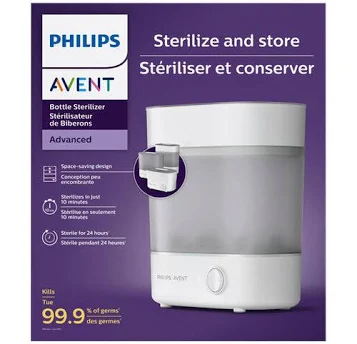
Philips Avent Electric Steam Steriliser
2. Philips Avent Microwave Steam Steriliser
If you want the cheapest reliable route, this is it. Water goes in the base, parts go in the tray and the microwave does the rest. It suits a small kitchen, a part-time combi-feeder who uses one or two bottles a day, and anyone who wants a second unit for grandparents or the car. Relative cost tier: lower.
The catch is that it ties up the microwave, you handle hot steaming parts afterwards, and capacity is smaller than an electric unit. The cycle length depends on your microwave’s wattage, and Philips Avent gives the timing for different wattages in the manual.
- Lowest cost and smallest footprint of any steam option.
- Cycle time is wattage-dependent, so check the manual for your microwave before the first use.
- No metal in the microwave: check that every bottle and part is marked microwave-safe.
- Ties up the microwave and needs careful handling of hot parts.
- Best for one or two bottles a day, not a full formula routine.

Philips Avent Microwave Steam Steriliser
3. Baby Brezza Sterilizer Dryer Advanced
This steams the load, then dries it with filtered hot air, so parts come out ready to store rather than dripping on the bench. For parents who find the daily wet-parts routine the most draining, that closing step removes one more thing from the list. Relative cost tier: high.
It is also the largest and most maintenance-heavy of the three steriliser picks. The manufacturer’s instructions say it needs descaling and a filter replacement on a set schedule, and the footprint is significant. Before ordering, check the product page for Australian plug, voltage and RCM marking, because Australian availability and variants can differ from overseas listings. It earns its place if bottles are a multi-times-a-day job, less so if you are mostly breastfeeding.
- Steam followed by a filtered-air drying stage, so parts come out dry without you doing anything.
- Check the product page for which bottles, teats, collars and pump parts it lists as compatible.
- The drying stage adds time, so look up the manufacturer’s stated cycle length in minutes.
- Large on the bench, so measure first.
- The replacement filter is an ongoing cost.

Baby Brezza Sterilizer Dryer Advanced
4. Baby Brezza Bottle Washer Pro
The Baby Brezza bottle washer is a different category, and it is the one most often bought by mistake. It is designed to wash bottles, teats and some accessories automatically using water, detergent and heat, and then dry them. Relative cost tier: highest.
Before treating it as a replacement for a steriliser, read the manual for two things: whether it claims to sterilise or only to sanitise, and by what method (heat, steam or something else). Also check the product page for Australian plug, voltage and RCM marking, because this model’s Australian availability should be confirmed rather than assumed. The trade-offs are cost, a very large footprint and limits on bottle shapes: the manufacturer’s instructions list which bottles and parts are compatible, and awkward items such as some pump components may still need a hand scrub.
- Automates the washing step that a plain steriliser leaves to you.
- Dries the load, which suits a high-volume formula or combi-feeding routine.
- Needs detergent, water and regular descaling and cleaning of its own.
- The largest and most expensive item here, with limits on bottle shapes and parts.
- The manufacturer states the cycle time and age guidance, so read both before buying.

Baby Brezza Bottle Washer Pro
Compare the four at a glance
| Product | Brand | Relative cost tier | Key features | Best for |
|---|---|---|---|---|
| Philips Avent Electric Steam Steriliser #1 | Philips Avent | Mid | Electric steam, hands-off cycle, no microwave needed | Most households, daily formula or expressed milk |
| Philips Avent Microwave Steam Steriliser Budget | Philips Avent | Lower | Microwave steam, compact, wattage-dependent cycle | Small kitchens, one or two bottles a day |
| Baby Brezza Sterilizer Dryer Advanced Premium | Baby Brezza | High | Steam plus filtered drying, large footprint | High-volume feeding, parents tired of wet parts |
| Baby Brezza Bottle Washer Pro | Baby Brezza | Highest | Automatic wash and dry, large footprint | Parents whose main pain is washing up |
Not sure yet? Put all 4 sterilising we rate next to each other.
Common steriliser questions, answered
Do I need a steriliser if I mostly breastfeed?
Often not a dedicated machine. If you give only the occasional bottle or express a little, a microwave tub, steam bags, boiling or Milton can cover it. Your child health nurse can tell you what suits your baby.
Can I sterilise a dummy or breast pump parts?
Often yes, as long as the parts are heat-safe, but follow the instructions that came with each item. Pump makers say some parts, such as tubing, should not be sterilised. Dummy makers give their own guidance on sterilising before first use and afterwards, so check the packaging.
How long do parts stay sterile after a cycle?
It varies by model, and the manufacturer states the window in the manual. The window assumes the lid stays closed, and it ends once parts are handled with unwashed hands. Follow the instructions for your unit rather than a general rule.
Can I just use the dishwasher instead?
A dishwasher cleans, and some bottle makers say their products are dishwasher-safe on the top rack. Whether a cycle counts as sterilising depends on the bottle manufacturer’s instructions and on the dishwasher, so check both. If your nurse has asked you to sterilise, use a method the bottle maker recommends for that purpose.
For most Australian families, the Philips Avent Electric Steam Steriliser is the one to buy: it runs hands-off and avoids the cost and bench space of a dryer. If money or space is tight, or you use only a bottle or two a day while combi-feeding, the Philips Avent Microwave Steam Steriliser is the budget alternative. Move up to the Baby Brezza Sterilizer Dryer Advanced only if wet parts are what is wearing you down, and consider the Baby Brezza Bottle Washer Pro only if washing up, not sterilising, is the real problem. Whichever you choose, check the product page for the Australian plug, voltage and RCM details first.
Where to buy these picks
✓ Verified prices are checked live at the retailer. Otherwise we show the approximate RRP (an indicative recommended price, not a live retailer price), or “price pending” where we don’t have one.
Philips Avent Electric Steam Steriliser
★ Best all-rounder
Baby Brezza Sterilizer Dryer Advanced
Best for high-volume feeding
All 5 prices we track for this pick
- The Memo $199 checked 23 Oct 2026
- Kiddie Country $199 checked 23 Oct 2026
- Baby Little Planet $199 checked 23 Oct 2026
- Whole Bubs $199.95 checked 24 Oct 2026
- Baby Kingdom $199.99 checked 23 Oct 2026
Baby Brezza Bottle Washer Pro
Best for hands-off washing
All 7 prices we track for this pick
- Tiny Tots $449 checked 24 Oct 2026
- Kiddie Country $449 checked 23 Oct 2026
- Baby Little Planet $449 checked 23 Oct 2026
- Baby Village $459 checked 23 Oct 2026
- Baby Kingdom $469.99 checked 23 Oct 2026
- The Memo $499.95 checked 23 Oct 2026
- Baby Zone $499.99 checked 23 Oct 2026
Philips Avent Microwave Steam Steriliser
Best for small kitchens
The shortlist, in your inbox
New winners, price drops and recalls worth knowing.