Best Baby Sleeping Bags Australia 2026: TOG-Rated Options for Aussie Seasons
Best Baby Sleeping Bags Australia 2026: TOG-Rated Options for Aussie Seasons
If you’re reading this at 2am with a phone brightness turned down low, you already know the two things keeping you up: the fear of anything loose in the cot, and the fact that Australia doesn’t really do “one season” nurseries. A sleeping bag that’s perfect in a Brisbane wet season will roast a baby in a Perth heatwave, and the one your sister swears by in Melbourne might be too thin for a Canberra frost. Add a nursery the size of a walk-in wardrobe and a newborn who’s just worked out how to Houdini out of a swaddle before the 4-month regression hits, and picking the right bag feels bigger than it should.
This guide is about cutting through the TOG confusion (that mysterious number on every tag) and giving you real, current products sold in Australia, matched to the seasons you’re actually dressing for. We’ve grounded every pick in the spec sheet, not a marketing blurb, and we’ll flag the honest trade-offs, including the ones brands don’t put on the box.
Whether you’re shopping for a newborn sleep sack before the birth, a transition bag for the regression, or a toddler sleeping bag for a big cot upgrade, the same rules apply: fit at the neck and armholes, the right TOG for the room temperature, and a zip you can operate half-asleep.
What to look for in a baby sleeping bag
A kids sleeping bag looks simple until you’re standing in the nursery aisle comparing five near-identical zip-up sacks. These are the specs actually worth checking before you buy.
- TOG rating matched to the season: TOG measures warmth, not size. A 0.2 to 1.0 TOG bag suits a warm Australian summer or a heated room, while 2.5 TOG and above is for winter in the southern states.
- Fitted neck and armholes: safe sleep guidance from Red Nose is built around nothing loose near a baby’s face, so a bag should sit snug at the neck and shoulders, not gape.
- Correct body length: a bag that’s too long lets a baby slide down inside it, which is exactly the smothering risk a sleeping bag is meant to remove.
- A two-way zip: bottom-to-top zips mean you can change a night nappy without fully undressing a sleeping baby, which matters more than it sounds at 3am.
- Room for hips and legs: healthy hip development needs a bag that lets knees bend and legs splay, not one that pins the legs straight.
- Fabric that breathes: cotton, bamboo and merino blends manage a baby’s temperature far better than fully synthetic linings, especially in humid coastal cities.
Understanding TOG ratings for Aussie seasons
TOG (thermal overall grade) tells you how much warmth a fabric traps, and it’s the single most useful number on any sleeping bag baby product. It was popularised in Australia by brands that also sell room thermometers alongside their bags, because the right TOG depends entirely on the nursery’s actual temperature, not the calendar date.
A rough TOG guide by room temperature
- 24°C and above: 0.2 TOG, or a sleeveless bag over just a nappy and singlet.
- 21 to 23°C: 1.0 TOG with a short-sleeve bodysuit underneath.
- 16 to 20°C: 2.5 TOG with long sleeves and socks.
- Below 16°C: 3.5 TOG or layering a 1.0 TOG bag with a light bodysuit and adding a beanie for sleep (only in a very cold, well-ventilated room).
There’s no single mandatory Australian Standard number stamped on sleeping bags the way there is for cots (AS/NZS 2172) or car seats (AS/NZS 1754), but sleeping bags sit close to children’s sleepwear territory, where flammability standard AS/NZS 1249 applies to nightwear fabrics and fit. Reputable Australian sleeping bag brands test against this standard even when a bag isn’t strictly classed as nightwear, which is worth checking on the swing tag if you’re buying a lesser-known brand.
Best baby sleeping bags Australia 2026
These are real, currently sold products, chosen for a genuine spec difference rather than a marginal colourway change. Some brands appear more than once because they simply cover more of the TOG range well.
1. ergoPouch Sleep Suit Bag 2.5 TOG
This is the bag most Australian parenting communities land on after trial and error, and the reason is versatility. The 2.5 TOG version suits most of the country through autumn and winter, and ergoPouch sells the same silhouette in 0.2 and 1.0 TOG, so families effectively buy one shape and swap the TOG as seasons change.
The bamboo-cotton blend breathes well in humid states, and the sizing runs from newborn right through to a toddler sleeping bag size for kids over two, which matters if you don’t want to keep restarting the size hunt every winter. Approx. RRP $70 to $90.
- Two-way zip for fuss-free night changes
- Sized from newborn through to around age 6 in the toddler range
- Fitted armholes and a tapered hem, in line with safe sleep fit guidance
- Trade-off: sits at the pricier end of the category, especially if you buy multiple TOGs

ergoPouch Sleep Suit Bag 2.5 TOG
2. Anko Sleeping Bag
Anko, the house brand behind a huge share of Australian nursery basics, makes a straightforward sleeping bag baby families reach for when they need a spare without overthinking it. It won’t have the layered TOG system of the boutique brands, but as a first bag or a backup for the change table, it does the core job.
Expect a simpler single TOG listing on the tag, a cotton-blend body, and sizing that tends to run true for age. Approx. RRP $20 to $30.
- The most affordable genuinely fit-for-purpose option in this guide
- Easy to buy a second or third as a backup without financial guilt
- Trade-off: limited TOG range compared with dedicated sleep brands, so it may not cover every season
- Trade-off: fabric and stitching quality is basic rather than premium
Anko Sleeping Bag
3. Love to Dream 24-7 Sleep Bag
Love to Dream built its name on the arms-up swaddle, and the 24-7 Sleep Bag is the transition version parents reach for right around the 4-month sleep regression, when startled arms are waking a baby who’s outgrowing the swaddle but isn’t ready for a plain bag.
It comes in 1.0 and 2.5 TOG and has zip-off wings that let you graduate a baby from arms-up, to one arm free, to both arms free, inside the same bag. That staged approach is genuinely useful for the regression window specifically. Approx. RRP $60 to $85.
- Designed around the exact transition stage that causes the most sleep loss
- Zip-off wings mean one bag covers several weeks of a fast-changing baby
- Two TOG options cover most of the year outside deep winter
- Trade-off: the wing mechanism is fiddly for some parents to master in the dark
Love to Dream 24-7 Sleep Bag
4. Grobag by The Gro Company Baby Sleep Bag
The Gro Company effectively invented the modern TOG-labelled baby sleep bag decades ago, and the current Grobag range still leans on that heritage with a wide TOG spread, including a heavier 3.5 TOG option that’s genuinely useful for a cold Tasmanian or Canberra bedroom without heating.
The cotton is soft and the print range is extensive, which matters if you’re trying to make a small nursery feel a bit less clinical. Approx. RRP $50 to $75.
- One of the few ranges to offer a true 3.5 TOG for very cold rooms
- Long-standing brand with consistent sizing across seasons
- Wide range of prints if aesthetics matter to you
- Trade-off: sizing can run slightly generous, so check the height chart rather than age alone
Grobag by The Gro Company Baby Sleep Bag
5. Purebaby Organic Cotton Sleeping Bag
Purebaby is an Australian label built around GOTS-certified organic cotton, and its sleeping bag is the pick for parents who specifically want to avoid synthetic linings against a baby’s skin, particularly for babies with eczema or sensitive skin, which is common in the dry winter months in southern states.
It’s a simpler single-TOG design rather than a full seasonal system, so you’re buying it for the fabric first and the temperature range second. Approx. RRP $50 to $65.
- GOTS-certified organic cotton, gentle on sensitive skin
- Australian-designed with classic, gender-neutral prints
- Trade-off: fewer TOG options than the dedicated multi-season brands above
- Trade-off: at the higher end for a single-TOG bag
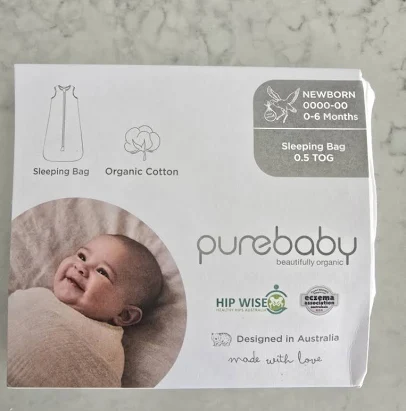
Purebaby Organic Cotton Sleeping Bag
How they compare
| Product | Brand | Approx RRP | Key features | Best for |
|---|---|---|---|---|
| Sleep Suit Bag 2.5 TOG #1 | ergoPouch | $70 to $90 | Bamboo-cotton blend, newborn to toddler sizing, multiple TOGs | Families wanting one shape across seasons and ages |
| Sleeping Bag Budget | Anko | $20 to $30 | Cotton-blend, single TOG, true-to-size fit | A backup bag or a low-cost first bag |
| 24-7 Sleep Bag Premium | Love to Dream | $60 to $85 | Zip-off wings, 1.0 and 2.5 TOG, staged arm transition | The 4-month regression and swaddle transition |
| Grobag Baby Sleep Bag | The Gro Company | $50 to $75 | Wide TOG range including 3.5 TOG, extensive prints | Cold-climate bedrooms without heating |
| Organic Cotton Sleeping Bag | Purebaby | $50 to $65 | GOTS-certified organic cotton, gentle on skin | Babies with eczema or sensitive skin |
Want to see how these stack up? We’ve reviewed 22 sleep aids in total.
mum. Approved: our top 3 for 2026
One shape that scales with a baby’s whole first few years across every TOG a parent will actually need.
A genuinely fit-for-purpose bag at a price that makes buying a spare an easy call.
Built specifically for the swaddle-to-bag transition that causes the most lost sleep.
Common mistakes to avoid
Even a well-reviewed bag can go wrong if it’s sized or layered incorrectly. Here’s what tends to trip parents up.
- Sizing by age instead of height and weight: most brands’ charts run on measurements, not months, and a long, lean baby can size up early.
- Doubling up on TOG by accident: pairing a 2.5 TOG bag with a fleece onesie underneath can push a baby into overheating, which is a genuine safe sleep risk.
- Buying a toddler sleeping bag too roomy: a bag with too much spare fabric around the shoulders defeats the purpose once a toddler is mobile in the cot.
- Ignoring the room thermometer: TOG guides assume a specific room temperature range, so a bag chosen off the season alone, without checking the actual room, is a guess.
- Skipping the two-way zip: a single top-only zip sounds fine until you’re trying to change a nappy without waking a baby fully.
Frequently asked questions
What TOG rating do I need for an Australian winter?
It depends on your actual room temperature more than your state. As a general guide, a room sitting between 16°C and 20°C suits a 2.5 TOG bag with long sleeves underneath, while a heated room closer to 21 to 23°C is better matched to a 1.0 TOG bag. Very cold rooms below 16°C are where a 3.5 TOG bag earns its place.
When can I move my baby from a swaddle to a sleeping bag?
Most Australian safe sleep guidance points to transitioning once a baby shows early signs of rolling, generally somewhere around 3 to 4 months, which also happens to be when the well-known sleep regression hits. A transition-style bag with arm options, rather than a full swaddle, is the usual middle step.
Are baby sleeping bags safer than loose blankets?
Red Nose and similar Australian safe sleep bodies recommend sleeping bags over loose blankets because a properly fitted bag can’t ride up over a baby’s face or become tangled the way a blanket can. The fit at the neck and shoulders is what matters most, not the brand.
What size sleeping bag should I buy for my baby’s age?
Check the height range on the label rather than the age label alone, since babies vary widely in length. Most brands list sizing in centimetres for exactly this reason, and a bag that’s too long increases the risk of a baby sliding down inside it.
Can toddlers still use a sleeping bag safely?
Yes, and many parents keep using a toddler sleeping bag well past the cot years because it discourages climbing out and keeps a wandering sleeper’s temperature steady. Look for a slightly roomier fit around the legs for a walking toddler, without excess fabric at the shoulders.
If we had to choose one, the ergoPouch Sleep Suit Bag 2.5 TOG is our 2026 pick for most Australian nurseries, because it covers the widest realistic TOG and size range without asking you to start over each season. On a tighter budget, the Anko Sleeping Bag won’t let you down as a genuinely usable first bag or backup, and if you’re specifically navigating the swaddle transition around the 4-month regression, the Love to Dream 24-7 Sleep Bag is worth the extra spend.
Where to buy these picks
✓ Verified prices are checked live at the retailer. Otherwise we show the approximate RRP (an indicative recommended price, not a live retailer price), or “price pending” where we don’t have one.
ergoPouch Sleep Suit Bag 2.5 TOG
★ Best one bag all seasons
Anko Sleeping Bag
Best low cost backup bag
Grobag by The Gro Company Baby Sleep Bag
Best for unheated bedrooms
Purebaby Organic Cotton Sleeping Bag
Best for sensitive skin
Love to Dream 24-7 Sleep Bag
Best for sleep regressions
The shortlist, in your inbox
New winners, price drops and recalls worth knowing.